
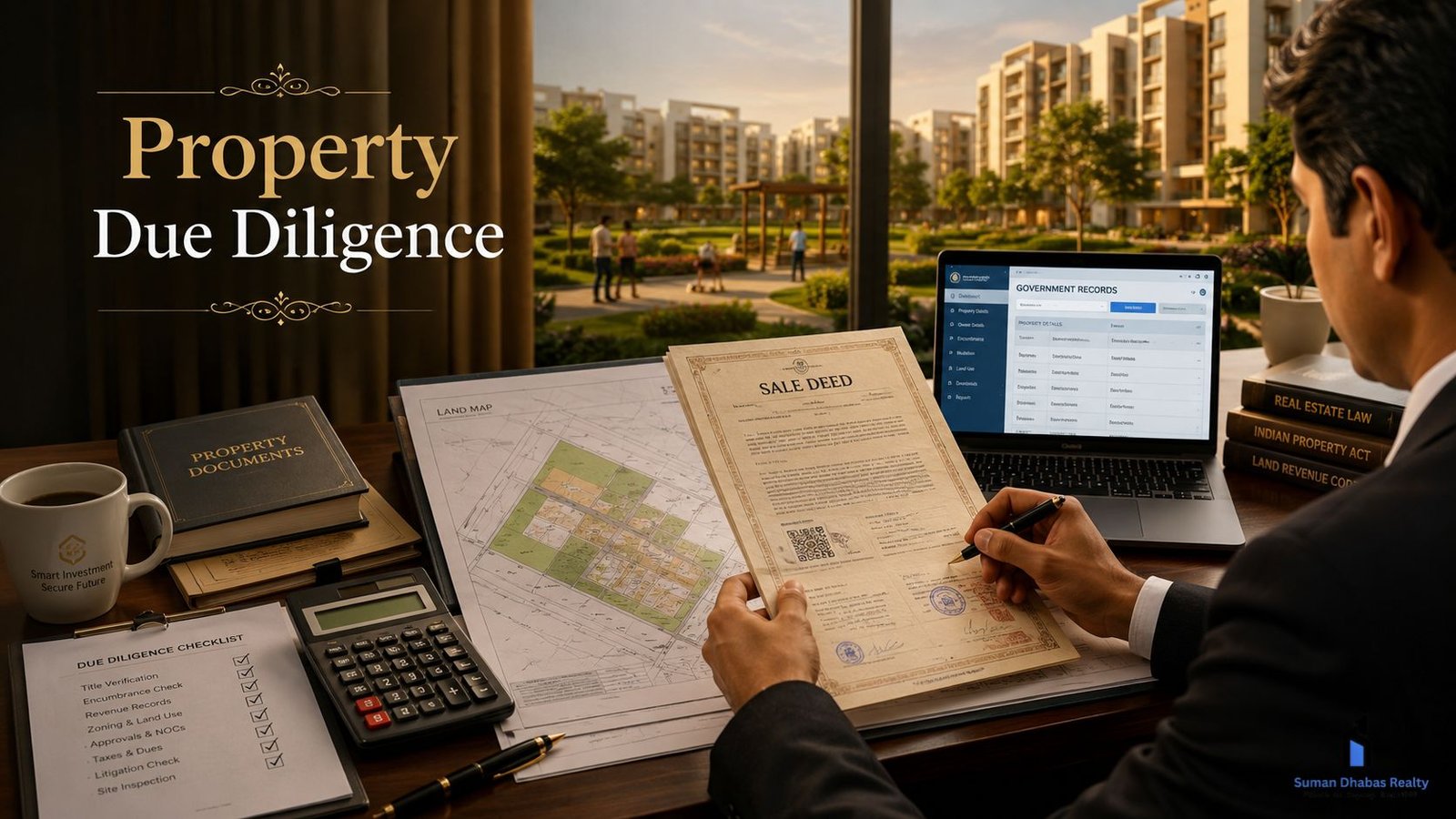
Buying real estate ranks among the most significant financial commitments you will ever make. While a breathtaking vista or a bargain price tag might instantly catch your eye, visual charm alone cannot guarantee a secure investment. That is precisely why property due diligence is non-negotiable. This process entails auditing a property’s legal chain, title deeds, government sanctions, revenue records, and physical status before committing your capital.
Whether you are eyeing a suburban plot, a modern apartment, or a parcel within an expanding township, rigorous verification shields you from expensive legal traps down the road. Treating due diligence as a mandatory safeguard—rather than an optional formality—is the single best move a homebuyer can make.
What Is Property Due Diligence?
Property due diligence is the comprehensive background investigation of a real estate asset before finalizing a purchase. The goal is straightforward: verify that the title is unencumbered, all paperwork is legally binding, and the land is fully sanctioned for your intended use.
A thorough due diligence audit covers key operational checkpoints:
Ownership Records: Confirming the current seller holds legitimate, marketable title.
Historical Deeds: Tracing the chain of title across prior purchase and transfer documents.
Revenue & Land Records: Cross-checking entries in state land registries.
Encumbrance Status: Screening for outstanding mortgages, liens, or institutional claims.
Tax Compliance: Verifying up-to-date property and municipal tax payments.
Sanctioned Plans: Reviewing local authority approvals, layout permits, and land-use classifications.
Regulatory Compliance: Auditing RERA registration details where applicable.
Legal Screening: Uncovering pending litigation, boundary disputes, or court stays.
Physical Survey: Measuring actual boundary markers against plot maps.
Ultimately, due diligence clarifies the exact legal and physical asset you are acquiring.
Why Is Property Due Diligence Important?
Real estate transactions require substantial upfront capital, and simple oversights at the signing table can turn into catastrophic financial liabilities. Unclear ownership records routinely trigger protracted legal battles, while discrepancies in registered dimensions versus ground reality can spark immediate boundary disputes with neighbors.
Front-loading your research minimizes these vulnerabilities:
Evidence-Based Decisions: Shifts your reliance away from developer pitch decks and verbal promises toward verifiable documentation.
Hidden Risk Discovery: Exposes silent issues—such as restrictive zoning laws, undisclosed bank liens, or active litigation—that remain completely invisible during a basic site visit.
Property Due Diligence Checklist for Buyers
Approaching verification systematically keeps the process efficient and thorough.
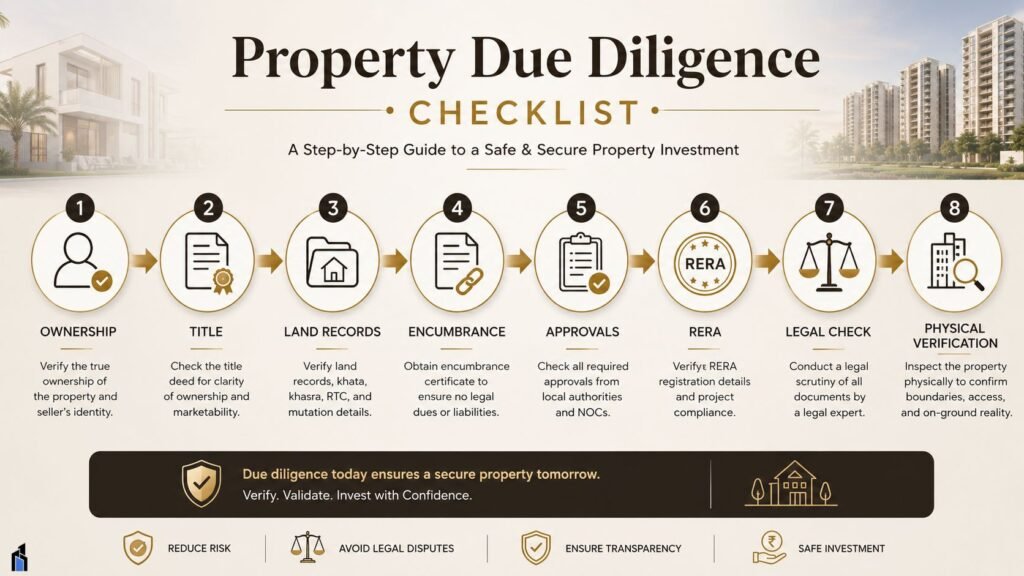
1. Verify the Property Owner
Confirm that the seller holds absolute authority to convey the asset. Cross-reference their government ID against current title deeds, and trace all previous conveyances to ensure no broken links exist in the ownership history.
2. Check the Title History
Review title continuity across decades to confirm clear, marketable ownership. If the transaction involves inheritance, legal heirs, or complex multi-party transfers, engage a qualified property attorney to review the chain.
3. Check Land Records
Local revenue portals provide instant visibility into ownership and land classifications. For example, buyers in Rajasthan can query the official Apna Khata portal to inspect registered mutation records. Note, however, that digital extracts serve primarily as preliminary reference points; you must still secure certified hard copies from the local sub-registrar’s office for legal validity.
4. Look for Encumbrances
Verify that the property is completely free from third-party financial liabilities. Request an updated Encumbrance Certificate (EC) from the sub-registrar to ensure the land isn’t pledged as bank collateral or tied up in unpaid debts.
5. Verify Approvals and Land Use
Ensure the property is zoned for your specific intent (e.g., residential vs. agricultural). Review master plan compliance, layout approvals, municipal access permissions, and setback compliance. This step is imperative when investing in developing residential corridors.
How to Perform Property Due Diligence for a Township
Master-planned townships demand an expanded verification strategy because you are buying into broader shared infrastructure alongside an individual lot:
Infrastructure Audit: Review master layouts to confirm designated green belts, public access roads, utility lines, and common amenities.
RERA Verification: For projects subject to real estate regulations, cross-check developer filings on the official state portal. The Rajasthan RERA database, for instance, allows buyers to search by promoter, registration number, or project status to verify completion timelines and escrow accounts.
Regional Due Diligence: If you are evaluating growing corridors—such as residential hubs surrounding Jaipur or Khatu Shyam—apply these strict validation parameters across all prospective projects, including developments by established entities like Suman Dhabas Realty Pvt. Ltd. Ground your decision in official approvals rather than promotional hype.
Property Due Diligence Before Paying the Final Amount
Perform your core documentation checks long before executing a binding sale agreement or transferring a major earnest deposit:
Audit Document Consistency: Compare plot numbers, precise dimensions, spellings, and dates across all historical documents.
Investigate Discrepancies Immediately: Pause negotiations if details clash or if a seller hesitates to furnish primary records. Transparent sellers readily accommodate standard verification efforts.
Final Thoughts
Property Due Diligence gives buyers a structured way to examine a property before making a major financial commitment. It covers much more than checking one sale deed. Ownership, title history, land records, approvals, encumbrances, registration details, legal disputes, and physical verification can all play an important role.
For buyers considering plots, homes, or township developments, careful research can provide greater confidence in the decision. Whether you are looking at a property near Jaipur, Khatu Shyam, or another developing location, never judge an investment only by its appearance or promised returns.
Take the time to verify the property first. After all, in real estate, a little research before buying can prevent much bigger problems later.



Pingback: Patta vs Registry: Key Differences
Pingback: Property NOC: Meaning, Types, Uses & Importance - Suman Dhabas Realty
Pingback: Property Resale Process: Steps, Documents & Key Checks - Suman Dhabas Realty
Pingback: RERA Number Meaning: How to Check & Verify a Project - Suman Dhabas Realty
Pingback: GujRERA 2.0: Features, Registration, Project Search & Guide - Suman Dhabas Realty
Pingback: GUJRERA: Registration, Rules and Property Buyer Guide - Suman Dhabas Realty
Pingback: Property Red Flags: 10 Warning Signs to Check Before Buying - Suman Dhabas Realty