
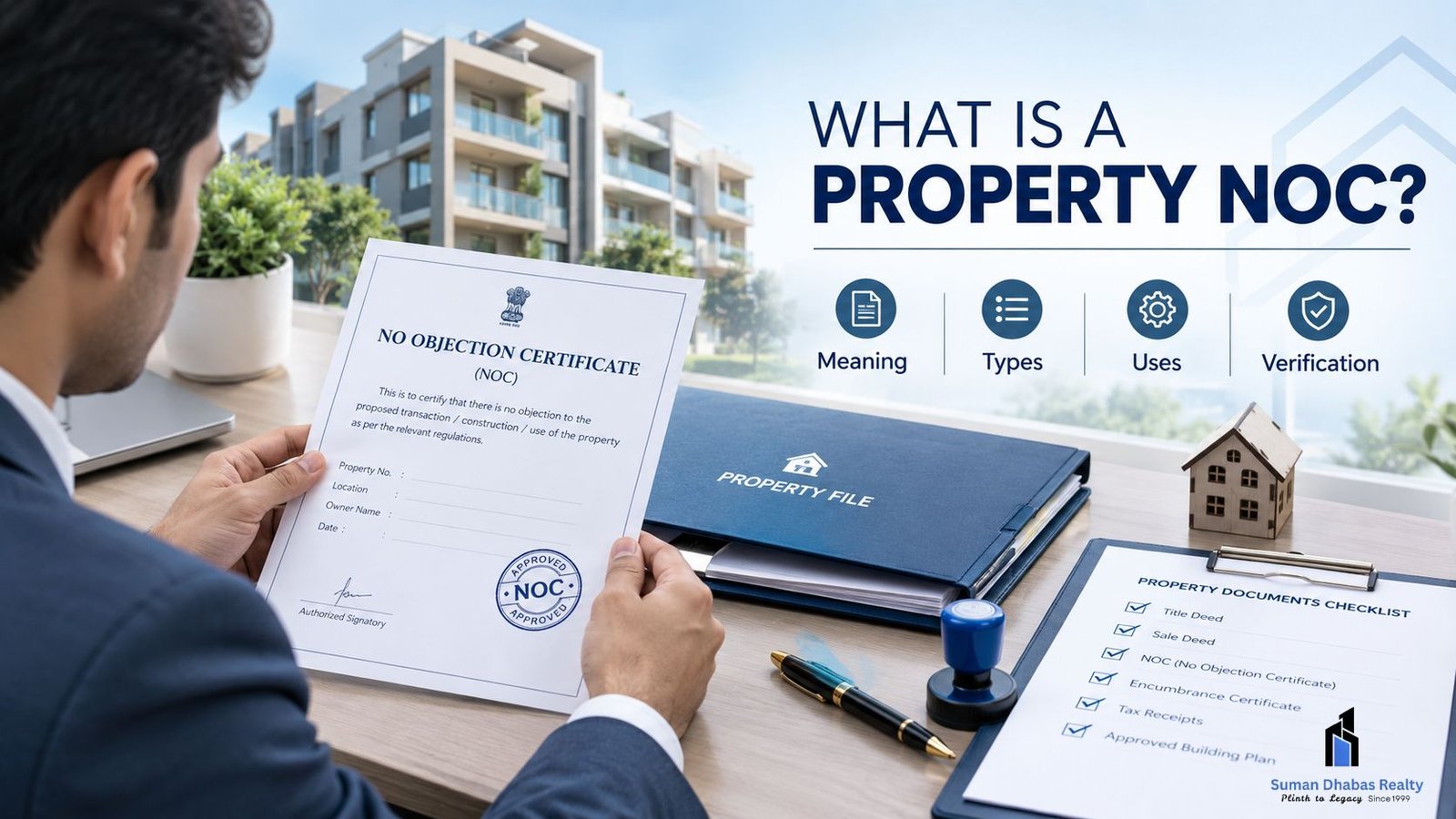
A Property NOC is a No Objection Certificate issued by a relevant authority, organisation or party to confirm that it has no objection to a particular property-related activity. The exact NOC required depends on the property, its location, ownership, development and the transaction involved.
For example, a property transaction may involve an NOC from a housing society, development authority, lender or another concerned department. In some cases, an NOC may also be required for specific construction or development activities. Therefore, buyers and sellers should not assume that one NOC covers every property-related requirement.
What Is a Property NOC?
NOC stands for No Objection Certificate.
A Property NOC generally confirms that the issuing authority or organisation has no objection to the activity mentioned in the certificate.
The important point is that an NOC is purpose-specific. It does not automatically prove that the entire property has a clear title or that every legal requirement has been completed.
For instance, a municipal authority may issue a particular NOC for one requirement, while a housing society may provide an NOC for a different matter.
Government guidance on building permissions lists several possible NOCs, including those related to property tax, fire, airports, heritage and pollution, depending on the circumstances.
Why Is a Property NOC Important?
A Property NOC can help establish that the concerned authority or organisation does not object to a specific transaction, construction activity or property-related request.
It can become particularly important when:
- A property is being transferred.
- A flat is being sold within a housing society.
- Construction requires specific departmental clearance.
- A property has a loan or charge that needs to be addressed.
- A development project requires approval from different authorities.
- A property falls within an area requiring special permissions.
However, the requirement varies from one property to another.
Therefore, buyers should first understand which NOC is required and why instead of simply asking for a generic NOC.
Common Types of Property NOC
1. Society NOC
A housing society may require or issue an NOC when a flat is being transferred to another owner, depending on the applicable rules and requirements.
Such a document can confirm the society’s position regarding the proposed transaction.
Rajasthan’s RERA-related legal due-diligence checklist, for example, includes checking a society’s No Objection Letter in applicable apartment or residential-complex transactions.
2. Bank or Lender NOC
If a property has been financed through a loan, the lender may have a charge or interest connected to the property.
When the loan is repaid, the relevant documentation from the lender becomes important for establishing that the lender’s claim has been addressed.
Buyers should therefore check whether any loan, mortgage or charge exists before completing a transaction.
3. Fire NOC
Certain buildings may require fire-related clearance based on their type, size, height or applicable local requirements.
In Rajasthan, the urban local-government system separately lists Fire NOC as a service, with applicable fees and requirements.
A fire NOC is particularly relevant for buildings where fire-safety approval is required.
4. Development Authority NOC
A development authority may issue an NOC for certain property-related activities.
For example, the Jaipur Development Authority’s service portal lists an Issue of No Objection Certificate service.
The exact requirement depends on the property and the activity for which permission is being sought.
5. Land-Use or Departmental NOC
Certain properties or activities may require permissions from specific departments.
For example, Rajasthan’s Forest Department lists different land-use NOCs and permissions for activities such as roads, electricity lines, industries and other projects.
Therefore, a buyer should check the property’s location and proposed use before assuming that no additional permission is needed.
Is a Property NOC the Same as a No-Dues Certificate?
No.
A No Objection Certificate and a No-Dues Certificate serve different purposes.
A No-Dues Certificate generally confirms that specified dues have been cleared. Urban-development guidance describes an NDC as certification that the relevant property or asset is free from specified encumbrances or dues in the context of the issuing authority.
An NOC, on the other hand, indicates that the issuing party has no objection to a particular activity.
Therefore, you should not treat an NOC and a No-Dues Certificate as interchangeable documents.
Is a Property NOC Proof of Clear Title?
No.
This is one of the most important points for property buyers.
An NOC does not automatically establish complete ownership or a clear title.
You should separately verify:
- Ownership documents
- Previous sale deeds
- Title history
- Encumbrances
- Property tax or other dues
- Approved layout
- Land-use status
- Building approvals
- Applicable permissions
- Physical boundaries
Rajasthan’s property-related due-diligence guidance also emphasises checking title, development agreements, approved plans, encumbrances, claims and statutory dues separately.
Therefore, an NOC should be treated as one part of property verification, not as a replacement for complete due diligence.
When Should You Check a Property NOC?
Ideally, check applicable NOCs before making a major financial commitment.
If you are purchasing a flat, ask whether the society or other relevant authority requires an NOC for the transfer.
If you are buying a plot, check whether any authority-specific permission applies to the land, its development or its intended use.
For a building, check the approvals and clearances relevant to its construction and occupation.
Most importantly, verify the document with the issuing authority whenever possible.
What Should You Check in a Property NOC?
Before relying on an NOC, check the following details:
- Name of the property owner
- Property or plot number
- Address of the property
- Date of issue
- Issuing authority or organisation
- Purpose of the NOC
- Reference or application number
- Conditions mentioned in the certificate
- Signature or authorised approval
- Validity, if applicable
Also compare the information in the NOC with the property’s other documents.
If the plot number, owner’s name or property description does not match, investigate the difference before proceeding.
How to Verify a Property NOC
Start by identifying the organisation that issued the NOC.
Next, check whether the certificate contains a reference number or other verification details.
Where an online verification facility is available, use the official portal. Otherwise, contact the issuing authority through its official channels.
For properties in Rajasthan, different property-related services are handled through different government systems. For example, e-Panjiyan handles registration-related functions, while JDA provides its own property and development services.
Therefore, always verify an NOC with the correct issuing authority, rather than relying only on a photocopy provided by a seller or agent.
Common Mistakes Buyers Should Avoid
Buyers often make mistakes when they assume that an NOC automatically makes a property safe.
Avoid these mistakes:
- Accepting an NOC without checking who issued it.
- Treating an NOC as proof of clear title.
- Ignoring the purpose of the NOC.
- Failing to compare the property details with other documents.
- Relying only on a seller’s photocopy.
- Ignoring expired or conditional permissions.
- Skipping independent legal verification.
If the property has complicated ownership, multiple authorities or unresolved documentation, professional legal advice can help.
Conclusion
A Property NOC is an important property document, but its meaning depends on who issued it and what it covers. A society NOC, bank NOC, fire NOC and development-authority NOC can all serve different purposes.
Therefore, property buyers should never treat an NOC as a universal certificate of property safety. Instead, identify the required NOC, verify its authenticity and compare it with the property’s title, approvals, dues and other records.
A careful document check before purchasing can help you identify issues early and make a more informed property decision.



Pingback: Approved Layout Plan: Meaning, Importance & Key Checks - Suman Dhabas Realty
Pingback: What Is Registry? Meaning, Process, Cost & Documents - Suman Dhabas Realty