
Buying a house, plot, or commercial space inevitably brings you face-to-face with the term “registry.” Put simply, a property registry is the formal government procedure used to record legal real estate documents. This process generates an official public record of the ownership transfer.
While registry is a vital milestone for any real estate transaction, it isn’t the only safeguard you need. Smart buyers must thoroughly investigate property titles, chain of ownership, land use permissions, and local municipal approvals before signing on the dotted line.
In Rajasthan, the Registration and Stamps Department oversees all property registrations. Through its official e-Panjiyan portal, the state offers streamlined digital services for property valuation, document creation, fee payments, and online appointment booking.
What Is Registry in Property?
To answer directly: a property registry is the act of filing a legal instrument with the designated Sub-Registrar of your jurisdiction.
When buying or selling real estate, the transaction terms are written into a sale deed—detailing the identities of both parties, property boundaries, financial figures, and mutually agreed terms. Presenting this deed to the registrar creates an official, legally recognized government entry.
Key Takeaway: Registering your document is essential, but it does not replace legal due diligence. You must still verify that the seller holds a clean, marketable title before finalizing your transaction.
Why Is Property Registry Important?
Real estate involves substantial financial investments, making legal clarity absolute priority. Registering your property document provides legally enforceable evidence of the legal transfer between buyer and seller.
Buyer and Seller Identities: Confirms who transferred the asset to whom.
Property Boundaries & Description: Clearly demarcates the physical land or structure.
Financial Details: Establishes the official sale consideration amount.
Terms & Signatures: Captures agreed conditions along with party signatures and witness attestations.
Note: Requirements can shift depending on your location and transaction type, so always verify local rules before heading to the registrar’s office.
What Is Registry vs Sale Deed?
While people often use these terms interchangeably, they refer to two distinct elements of the purchase process:
| Term | Definition | Primary Function |
| Sale Deed | The physical or digital legal document | Outlines ownership transfer, price, and terms |
| Registry | The administrative government process | Validates and logs the deed in official state records |
When someone mentions “completing the property registry,” they are referring to executing the administrative filing of their sale deed with local authorities.
What Is Registry Process in Rajasthan?
Rajasthan’s e-Panjiyan portal structures property registration into clear digital and offline phases:
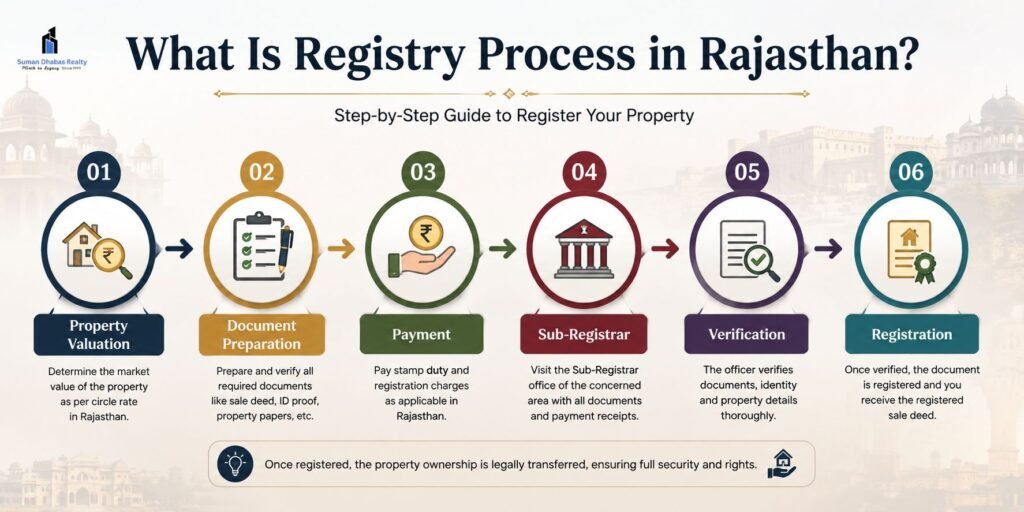
Property Valuation: Input asset details into e-Panjiyan to determine the property value based on District Level Committee (DLC) rates.
Party Data Entry: Enter accurate identity and address information for both buyer and seller to avoid future legal discrepancies.
Deed Preparation: Draft the sale deed using recommended legal templates. The portal provides automated tools for drafting common documents.
Fee Payment: Calculate and pay the necessary stamp duty, registration fees, and municipal surcharges directly through the portal’s integrated payment gateway.
Physical Submission: Schedule an appointment and present your draft deed alongside supporting certificates at the local Sub-Registrar Office (SRO).
Biometric Verification & Registration: The Sub-Registrar verifies original records, captures biometric data (fingerprints and photos), signs off, and issues your registered deed copy.
Documents Required for Property Registry
Although required paperwork varies based on property type, standard transactions generally require:
Drafted Sale Deed or Transfer Deed
Government-issued ID and address proofs (Aadhaar, PAN card, Passport)
Property tax receipts and previous title deeds (chain documents)
Valuation statement and online payment receipts
Passport-sized photographs of buyer, seller, and witnesses
Required affidavits or NOCs (No Objection Certificates), if applicable
Check the latest checklist on the official e-Panjiyan portal before your SRO appointment to ensure complete documentation.
What Is Registry Cost?
There is no fixed universal cost for property registration. Instead, final expenses are calculated based on multiple dynamic variables:
Market/DLC Valuation: Calculated based on area rates rather than just the sale price.
Stamp Duty & Registration Fees: Set by state policy, often varying by gender, property type, or municipal zone.
Local Surcharges: Additional fees for infrastructure development or specific local bodies.
Avoid relying on outdated third-party online calculators. Calculate your exact charges using current rates on the official e-Panjiyan platform.
What Is Registry Without Property Verification?
Completing a registry without verifying property records is a significant risk. Even if a seller hands over a signed deed, you should independently verify all background details:
Ownership Chain: Review past sales deeds to ensure an unbroken ownership trail.
Encumbrance Check: Confirm there are no active mortgages, legal stays, or outstanding bank liens.
Land Use & Approvals: Verify that the land is converted for residential/commercial use and holds appropriate master plan sanctions.
Dues & Taxes: Ensure electricity bills, water dues, and property taxes are fully cleared.
The e-Panjiyan portal features an online e-Search function. This tool lets you search historical registration records by district, SRO, party name, or document number to verify title history.
Property Registry for Township Projects
Purchasing a plot or villa within a master-planned township requires extra attention to project-level documentation. Beyond standard sale deeds, buyers must check developer layout approvals, land conversion certificates, and access permissions.
This is especially relevant in high-growth corridors around Jaipur and the Khatu Shyam region. As buyers look toward developing suburban hubs for long-term investments, evaluating developers—such as Suman Dhabas Realty Pvt Ltd in the Khatu Shyam region—requires examining the project’s foundational legal clearances before executing any registry document.
Always align your purchase with your personal timeline, budget, and long-term legal security.
What Is Registry? Final Answer
Property registry is the official legal recording of a property transfer with state government authorities. It serves as public proof of ownership, making it a critical step in your real estate purchase.
However, registration alone does not protect against title defects or undisclosed disputes. True security comes from thorough due diligence: verifying past title deeds, confirming land-use approvals, checking municipal clearances, and reviewing state records via e-Panjiyan.
Take your time during the purchase process, verify every document through official state portals, and consult a qualified property advocate for complex transactions. Proper preparation ensures your real estate investment remains safe and legally sound.



Pingback: Patta vs Registry: Key Differences
Pingback: What Is JDA Patta? Meaning, Benefits & Property Check - Suman Dhabas Realty