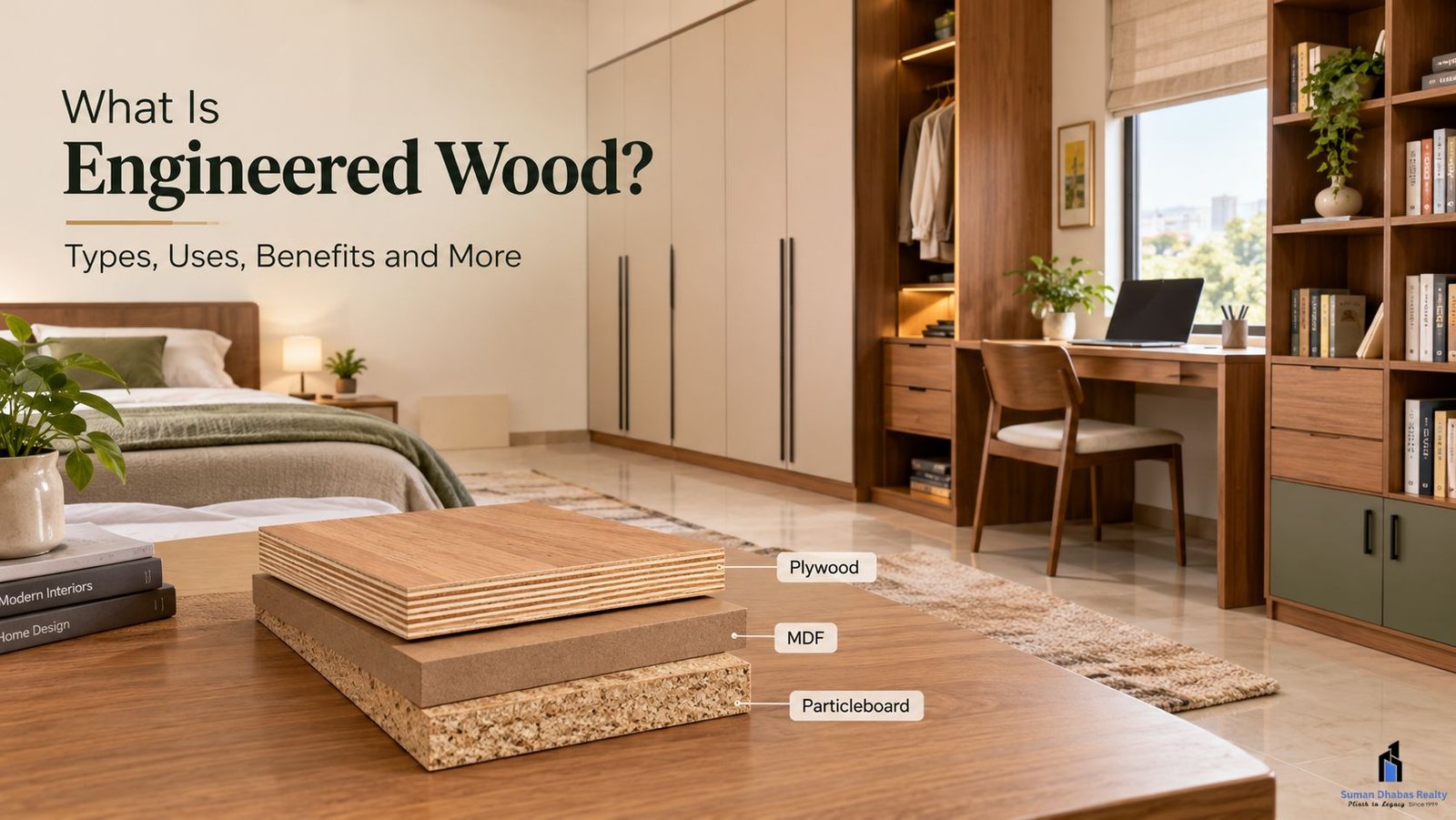
What is engineered wood? Engineered wood is a wood-based material made by combining wood pieces, fibres, strands, veneers, or other wood elements with adhesives. Manufacturers then press or bond these materials to create boards, panels, or structural products. Unlike solid wood, it does not always come from one continuous piece of timber.
Engineered wood can offer consistent dimensions and useful performance for different applications. Common examples include plywood, medium-density fibreboard (MDF), particleboard, oriented strand board (OSB), laminated veneer lumber, and other composite products. The exact properties depend on the type and manufacturing process.
Because different products have different strengths, it is important to choose engineered wood according to where and how you plan to use it.
How Is Engineered Wood Made?
The manufacturing process varies between products. However, most engineered wood products begin with smaller pieces or layers of wood.
For example, plywood uses thin sheets of wood veneer. Manufacturers arrange the veneers in layers and bond them together. The grain direction usually changes between layers, which helps create a stable panel.
MDF follows a different process. It uses fine wood fibres that manufacturers combine with a bonding system and press into panels under controlled conditions. Particleboard uses small wood particles that are pressed together with resin.
This controlled manufacturing process allows manufacturers to produce boards with relatively uniform dimensions and specific characteristics.
Types of Engineered Wood
1. Plywood
Plywood consists of multiple layers of wood veneer bonded together. It is widely used in furniture, cabinetry, interior work and construction.
Its layered structure gives it good strength and stability for many applications. However, its performance depends on the grade, thickness, core construction and intended use.
2. MDF
MDF, or medium-density fibreboard, is made from fine wood fibres. It has a smooth and uniform surface, which makes it useful for painted furniture, cabinets, shelves, decorative panels and interior applications.
MDF is easy to machine and provides a consistent surface. However, standard MDF can be sensitive to moisture, so the correct grade should be selected for areas where humidity is a concern.
3. Particleboard
Particleboard is made by pressing wood particles with resin. It is commonly used in furniture and interior products.
It can be a practical choice where cost and basic functionality matter. However, its moisture resistance and strength can differ from other engineered wood products.
4. OSB
Oriented strand board uses wood strands arranged in specific directions and bonded under pressure. It is mainly associated with structural applications, including sheathing and other building uses.
5. Structural Engineered Wood
Some engineered wood products are designed specifically for structural work. These include products such as laminated veneer lumber, laminated strand lumber, glue-laminated beams and wood I-joists. Such products are manufactured to provide specific structural characteristics and are different from furniture-grade boards.
What Is Engineered Wood Used For?
What Is Engineered Wood Used For in Homes?
Engineered wood has many residential applications. Depending on the product, it can appear in furniture, wardrobes, kitchen cabinets, shelves, doors, wall panels, flooring systems and structural components.
For instance, MDF can work well for smooth painted furniture surfaces. Plywood can suit applications where strength and dimensional stability are important. Particleboard is often found in cost-conscious furniture products.
Therefore, there is no single engineered wood product that works best for every situation.
Benefits of Engineered Wood
One major advantage is consistency. Factory production allows manufacturers to control thickness, dimensions and composition more precisely than with many naturally varying pieces of timber.
Engineered wood can also make efficient use of smaller wood components. Depending on the product, manufacturers can use veneers, fibres, strands or particles that would not form a conventional solid-wood board on their own.
Another benefit is versatility. Different manufacturing methods create products for furniture, decorative work, flooring and structural construction.
Engineered wood can also provide a uniform surface for laminates, veneers, paint and other finishes. This makes it useful in modern interior design.
Limitations of Engineered Wood
Engineered wood is not automatically suitable for every application. Different products have different moisture resistance, strength and durability.
Some boards can swell or lose performance when exposed to excessive moisture. Therefore, kitchens, bathrooms and other humid areas require suitable materials and proper protection.
Adhesives also matter. Certain composite wood products can contain resins that release formaldehyde. For this reason, buyers should check product specifications, emission information and applicable standards when indoor air quality is a concern.
In addition, it should not be treated as one single material. MDF, plywood and particleboard have different characteristics and should be compared according to their intended use.
Engineered Wood vs Solid Wood
The main difference lies in how the material is produced. Solid wood comes from natural timber and retains the characteristics of the original piece. Engineered wood combines smaller wood components or layers to create a manufactured product.
Solid wood can offer a distinctive natural appearance and can often be repaired or refinished in different ways. Engineered wood, meanwhile, offers greater consistency and a wide range of options for specific applications.
The right choice depends on factors such as budget, location, appearance, moisture exposure, expected load and maintenance requirements.
How to Choose Engineered Wood for Your Home
Start by identifying the purpose of the material. A wardrobe panel may require different properties from a structural beam or kitchen cabinet.
Next, check the board’s thickness, grade, moisture resistance and surface finish. For furniture, also consider the type of laminate, veneer or paint that will cover the board.
It is equally important to buy from a reliable manufacturer or supplier. Ask for product specifications when necessary. For areas exposed to moisture, select a product designed for that environment rather than relying only on appearance.
For people planning homes or plots in developing residential areas, material selection is only one part of the larger planning process. Suman Dhabas Realty Pvt Ltd focuses on planned real-estate developments and residential opportunities in Jaipur and other emerging locations.
Is Engineered Wood a Good Choice?
Engineered wood best suited for depends on the product you choose. Plywood, MDF, particleboard, OSB and structural engineered wood each serve different purposes.
For home interiors, engineered wood can provide practical options for furniture, cabinets, panels and other applications. However, buyers should compare the material’s grade, moisture resistance, strength, finish and intended use before making a decision.
In short, it is not simply a substitute for solid timber. It is a broad category of manufactured wood products designed for different needs. Understanding those differences makes it easier to select the right material for a home, renovation or construction project.