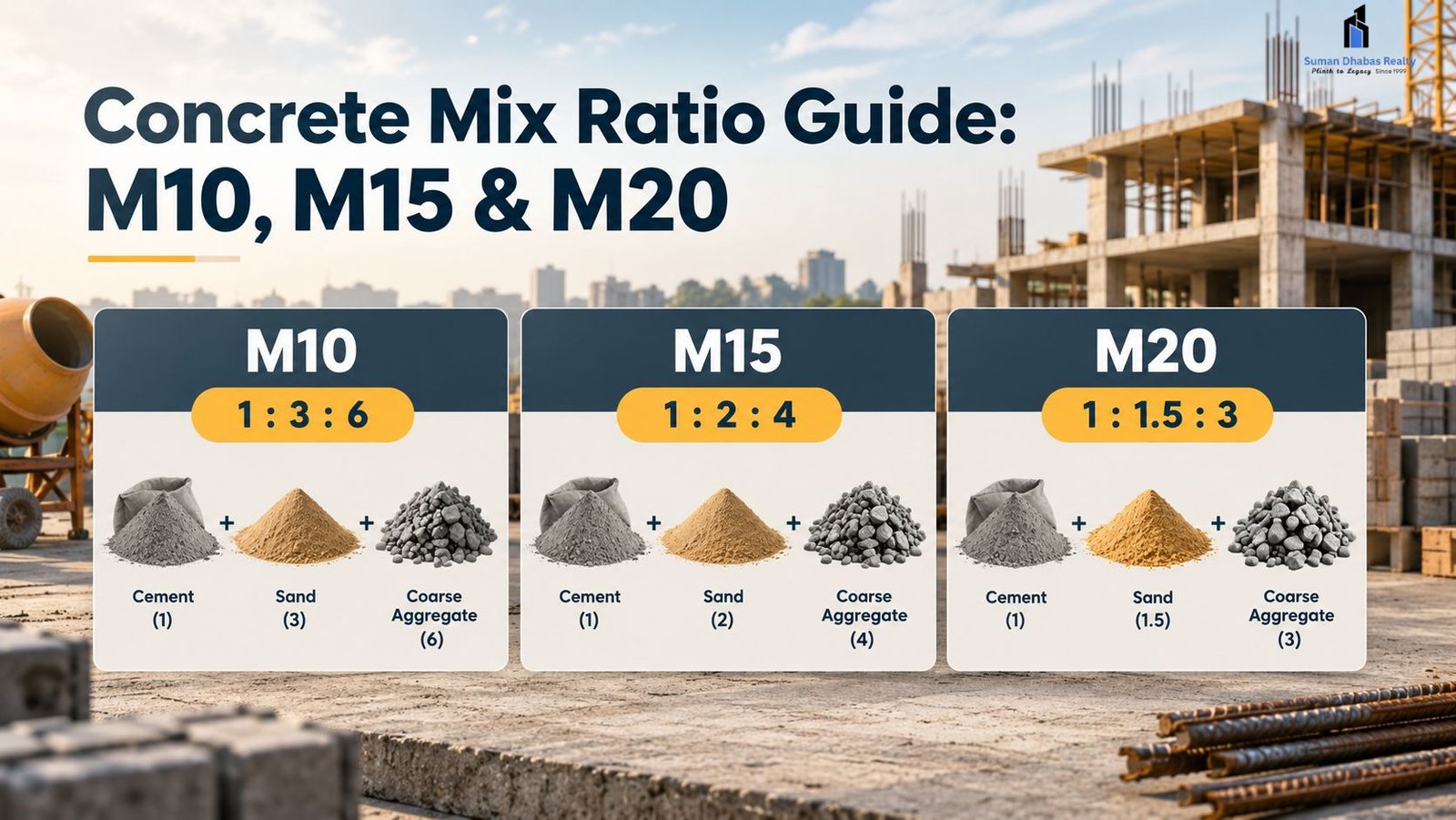
A concrete mix ratio defines how much cement, sand and coarse aggregate go into a concrete mix. Builders use different proportions to achieve different concrete grades and performance levels. Among the commonly discussed grades in India, M10, M15 and M20 have specific nominal proportions. However, structural construction should always follow the approved design and applicable standards.
The mix ratio usually describes the proportion of cement, sand, and coarse aggregate. However, the exact mix required for structural work depends on the project specifications and applicable standards. Therefore, a simple ratio should not replace an approved design mix.
What Is a Concrete Mix Ratio?
A concrete mix ratio represents the proportion of cement, fine aggregate and coarse aggregate in a concrete mixture. The ratio normally appears in this order:
Cement : Sand : Coarse Aggregate
For example, a 1:2:4 mix uses one part cement, two parts sand and four parts coarse aggregate. Workers traditionally measure these materials by volume for nominal mixes.
Water does not form part of this three-number ratio. Instead, the required water content depends on factors such as workability, materials and the intended concrete application. Therefore, adding water without proper control can affect the final concrete quality.
Concrete Mix Ratio Guide for Common Grades
The commonly referenced nominal proportions for these three grades are:
| Concrete Grade | Common Ratio* | General Application |
|---|---|---|
| M10 | 1:3:6 | PCC and general non-structural work |
| M15 | 1:2:4 | Plain concrete and selected general works |
| M20 | 1:1.5:3 | Commonly referenced for ordinary RCC work |
| M25 and above | Design-dependent | Structural applications requiring designed proportions |
The letter M refers to the concrete mix, while the number indicates the characteristic compressive strength in N/mm² at 28 days.
However, these ratios should not become a substitute for an engineer-approved mix design. Project requirements, exposure conditions and material properties can change the required proportions.
M10 Concrete Mix
The M10 concrete mix ratio is commonly given as 1:3:6. It contains one part cement, three parts sand and six parts coarse aggregate.
M10 represents a lower-strength concrete grade compared with M15 and M20. Contractors may use it for suitable plain concrete applications where the project specification permits it.
Before using M10, check the construction drawings and technical specifications. The intended application should determine the concrete grade.
M15 Concrete Mix
The M15 ratio is 1:2:4. In this proportion, one part cement combines with two parts sand and four parts coarse aggregate.
M15 provides a higher characteristic strength than M10. Therefore, it can suit certain general concrete applications when the project specification calls for this grade.
Even so, builders should not select M15 simply because its ratio appears suitable. Instead, they should follow the requirements established for the particular construction work.
M20 Concrete Mix
The M20 concrete mix ratio is commonly stated as 1:1.5:3. This means one part cement, 1.5 parts sand and three parts coarse aggregate.
M20 has a characteristic compressive strength of 20 N/mm² at 28 days. It commonly appears in discussions about residential construction and structural concrete.
However, structural members such as beams, columns and slabs require proper engineering design. Consequently, workers should follow the specified mix design rather than choosing a ratio based only on general guidelines.
Why Is Water Important in Concrete?
Water plays an important role in concrete because it allows cement to hydrate and helps produce a workable mixture.
However, adding excess water can affect concrete performance. More water may make the mixture easier to place, but uncontrolled water addition can reduce strength and durability.
For this reason, the water-cement ratio needs proper control. Site teams should follow the specified mix and avoid adding water simply to make concrete more fluid.
Workability can also be managed through suitable admixtures when specified by the mix design.
Nominal Mix vs Design Mix
A nominal mix uses a predetermined proportion of ingredients. It provides a simple approach for certain lower-grade applications where such mixes are permitted.
A design mix is different. It considers the required grade, material properties, workability, exposure conditions, durability requirements, and other project factors.
Therefore, the concrete mix ratio guide should be treated as an educational reference rather than a structural design document.
For important structural elements, engineers generally specify the required concrete grade and approved mix based on the applicable standards and project conditions.
Factors That Affect Concrete Quality
The ratio is only one part of concrete production. Several other factors can affect the finished material.
1. Quality of Materials
Cement should be suitable for the intended application. Sand should have appropriate properties, while coarse aggregate should meet the required size and quality specifications.
2. Accurate Batching
Incorrect measurement can change the intended proportion. Consistent batching helps maintain uniformity between different batches.
3. Water Control
Too much water can change the mix significantly. Therefore, water should be measured and controlled rather than added by guesswork.
4. Mixing
Proper mixing helps distribute cement, water, and aggregates more evenly. Inadequate mixing can result in inconsistent concrete.
5. Compaction and Curing
Fresh concrete needs proper compaction to reduce unwanted voids. After placement, curing helps maintain suitable moisture conditions for cement hydration and strength development.
Concrete Mix Ratios and Residential Construction
For homeowners, understanding the concrete mix ratio guide can make construction discussions easier. It can help you understand terms such as M10, M15, M20, cement, sand, aggregate, and design mix.
However, homeowners should not select a structural concrete ratio solely from an online table. The engineer, contractor, or project specification should determine the appropriate concrete grade and mix for structural members.
This becomes especially relevant in planned residential developments, where foundations, roads, drainage systems, and other construction elements may have different technical requirements.
Suman Dhabas Realty Pvt Ltd works with residential and plotted development projects, including developments connected with the wider Jaipur and Khatu Shyam region. Its projects can be evaluated not only for location and planning but also through the usual property and construction checks. For buyers, understanding basic construction terminology can make technical discussions with project teams easier.
Common Mistakes to Avoid
One common mistake is assuming that every concrete grade has one universal recipe. In practice, project specifications and material properties matter.
Another mistake is adding extra water without checking the approved requirements. This can change the water-cement ratio.
Using inconsistent measurement methods is another concern. If cement is measured by one method and aggregates by another, the intended proportion may not remain consistent.
Finally, a ratio should never be considered a guarantee of strength. Testing, material quality, batching, placement, compaction, and curing all influence the final result.
Final Thoughts
A concrete mix ratio guide provides a useful introduction to the proportions associated with common concrete grades. M10, M15, and M20 are frequently discussed in residential construction, with traditional ratio references such as 1:3:6, 1:2:4, and 1:1.5:3 respectively.
Still, construction should follow the applicable standards and project requirements. For structural concrete, an approved design and proper site quality control are more important than simply following a generic ratio.
Understanding the basics is useful. Applying them correctly requires suitable technical guidance, accurate materials, controlled batching, and proper construction practices.