
Choosing where to live is just as important as choosing the property itself. A house or residential plot may have the right size and price, but the surrounding location can have a major effect on everyday convenience, travel, comfort, and future plans. This is why understanding how to choose a residential location is an important part of the property-buying process.
A suitable residential area should fit your lifestyle and financial plans. It should also provide convenient connectivity, essential facilities, dependable infrastructure, and a comfortable environment. If you are considering a home or residential plot in Jaipur, studying the location carefully before making a decision can help you choose more confidently.
Start With Your Lifestyle and Priorities
There is no single residential location that works equally well for everyone. Your ideal area depends on how you plan to use the property and what matters most in your daily life.
For example, someone who travels regularly may give greater importance to road connectivity, while a family may focus more on schools, healthcare, parks, and nearby markets.
Before comparing locations, identify your practical requirements. Consider your daily travel, family needs, preferred surroundings, and available budget. This gives you a clearer basis for evaluating different areas.
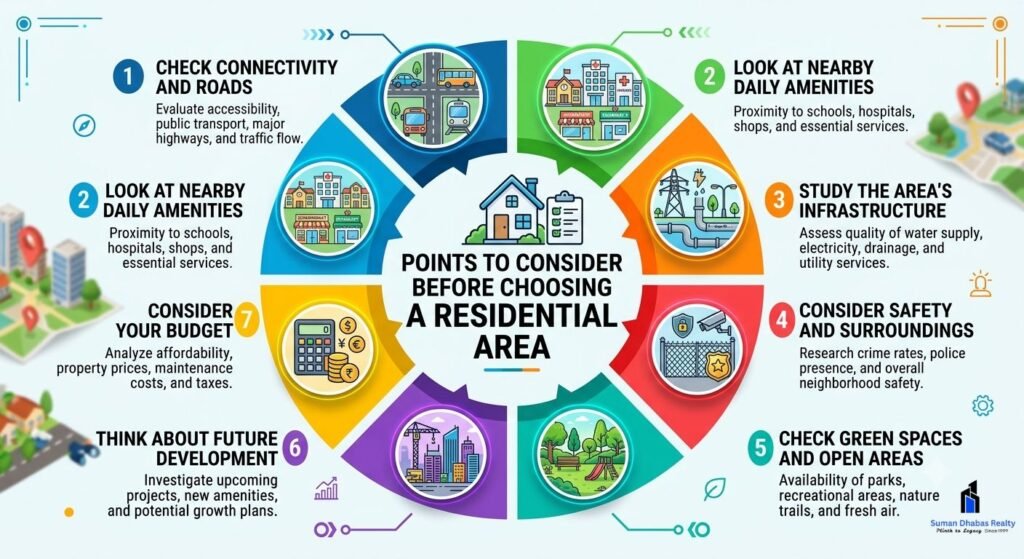
Examine Road Connectivity
Easy access to major roads can make daily travel considerably more convenient. Start by checking the routes connecting the location with important parts of the city.
Consider how easily you can reach:
- Workplaces
- Schools and colleges
- Shopping areas
- Healthcare facilities
- Other frequently visited destinations
Do not stop at the main roads. Internal access is equally important, especially when purchasing a residential plot. Check the condition and width of the roads leading to the property.
Good city-level connectivity will not be very useful if the final approach to the plot is difficult. Think about access for private vehicles, visitors, and emergency services as well.

Check What You Can Access Nearby
A convenient residential area does not necessarily need every facility at its doorstep. However, important everyday services should be reasonably accessible.
While visiting a location, find out whether the surrounding area has facilities such as:
- Schools and colleges
- Hospitals and clinics
- Grocery shops and markets
- Banks and ATMs
- Restaurants and cafes
- Parks
- Public transport
Also think beyond your present situation. Your requirements may change over time, particularly if your family grows. A location that meets your needs today should ideally remain practical in the future.

Evaluate Basic Infrastructure
Infrastructure is one of the most practical factors to examine before purchasing property. A location may look attractive, but its actual living experience can depend heavily on the basic services available there.
Look at the condition and availability of:
- Roads
- Drainage
- Electricity
- Water supply
- Street lighting
- Waste management
It is also important to distinguish between existing facilities and proposed facilities. A service that is only planned should not be treated as though it already exists.
When evaluating a plotted development, examine the complete layout. Internal roads, open areas, landscaping, utility arrangements, and other planned features should all be considered.
Whenever possible, verify important claims through reliable information rather than depending entirely on advertisements or verbal assurances.
Pay Attention to the Surrounding Environment
The area around a property can influence your overall living experience. During a site visit, observe what the neighbourhood feels like rather than focusing only on the property itself.
Look at factors such as traffic, lighting, nearby activity, cleanliness, and the general condition of the surroundings. Visiting at different times can also give you a more realistic picture of the area.
For families, open spaces and nearby parks may provide additional value. These areas can offer places for children to play and for adults to walk or spend time outdoors.
Look Beyond the Plot or House
When comparing residential locations, it is easy to concentrate on the individual property. However, the wider neighbourhood deserves equal attention.
Consider the balance between built-up areas and open spaces. Trees, landscaped areas, walking spaces, and parks can contribute to a more open and comfortable residential environment.
This is particularly relevant when evaluating planned developments. The overall layout can affect how residents experience the community, not just how the individual plot looks.
Research Future Development Carefully
The present condition of a location is important, but its surrounding development can also affect its future character.
Observe construction activity and available information about developments such as:
- New roads
- Commercial areas
- Educational facilities
- Other infrastructure projects
Such developments may influence how an area evolves. However, proposed projects should not automatically be treated as guaranteed outcomes.
When considering future growth, focus on information that can be verified. Avoid basing a property decision entirely on assumptions or speculation about what might happen later.
Make Sure the Location Fits Your Budget
Location and budget need to be considered together. Different parts of a city can have significant differences in property prices.
A highly sought-after location may provide strong connectivity and access to amenities, but it may also require a larger financial commitment. Before making a choice, establish a comfortable spending limit.
Also account for expenses beyond the property purchase. Depending on your plans, these may include registration, construction, interiors, maintenance, and other costs.
If you are purchasing a plot with plans to construct a home later, construction expenses should be included in your overall financial planning.
A location with slightly lower property costs but suitable infrastructure and development may sometimes be more practical than an expensive area that places too much pressure on your finances.
Never Skip the Physical Site Visit
Online research can help you create a shortlist, but it cannot fully replace seeing the location yourself.
During a site visit, inspect the property and its surroundings. Pay attention to:
- Road conditions
- Traffic
- Nearby facilities
- Open spaces
- General surroundings
- Accessibility
If possible, visit the location at different times of the day. Morning, afternoon, and evening visits can reveal differences in traffic, activity, and the overall environment.
Speaking with people familiar with the area can also provide useful practical observations that may not be available through online research.
Consider the Benefits of Planned Residential Developments
Understanding how to choose a residential location also means looking at the development as a whole rather than judging a plot in isolation.
Planned townships can bring features such as residential plots, internal roads, open spaces, landscaping, and community-focused planning together within one development.
For buyers planning to construct their own homes, a plotted development can provide flexibility while offering an organised residential setting.
Suman Dhabas Realty Pvt. Ltd. works in the plotted-development space and has a broader real estate portfolio that includes plotted developments and other property projects. However, buyers should evaluate every project independently by considering its location, layout, infrastructure, documentation, and suitability for their requirements.
A Practical Way to Compare Residential Locations
Instead of choosing an area based on one attractive feature, compare different locations across several factors.
You can assess each option based on:
- Connectivity – How easily can you reach important destinations?
- Amenities – Are essential daily facilities available within a reasonable distance?
- Infrastructure – Are roads, drainage, electricity, water, lighting, and waste management adequate?
- Environment – Is the surrounding area comfortable, clean, and organised?
- Open spaces – Are parks, landscaped areas, or other green spaces available?
- Development – Is there verified infrastructure or construction activity that may influence the area?
- Affordability – Does the location fit comfortably within your complete property budget?
This broader comparison can help you avoid making a decision based only on price or appearance.
Final Takeaway

Knowing how to choose a residential location requires more than finding an attractive property at an acceptable price. The surrounding area can influence daily travel, access to essential services, comfort, and long-term residential plans.
Start by understanding your lifestyle and budget. Then examine road access, nearby amenities, infrastructure, safety, open spaces, and the current surroundings. Research future development carefully, but avoid treating proposed projects as guaranteed benefits.
Most importantly, visit the location yourself and inspect the wider neighbourhood. For a residential plot, remember that the value of the decision extends beyond the piece of land itself. The roads, facilities, environment, and development around it can shape your experience for years to come.
A thoughtful location decision balances what you need today with what may matter to you in the future. Careful research and realistic expectations can help you select a residential area that suits both your home plans and your budget.