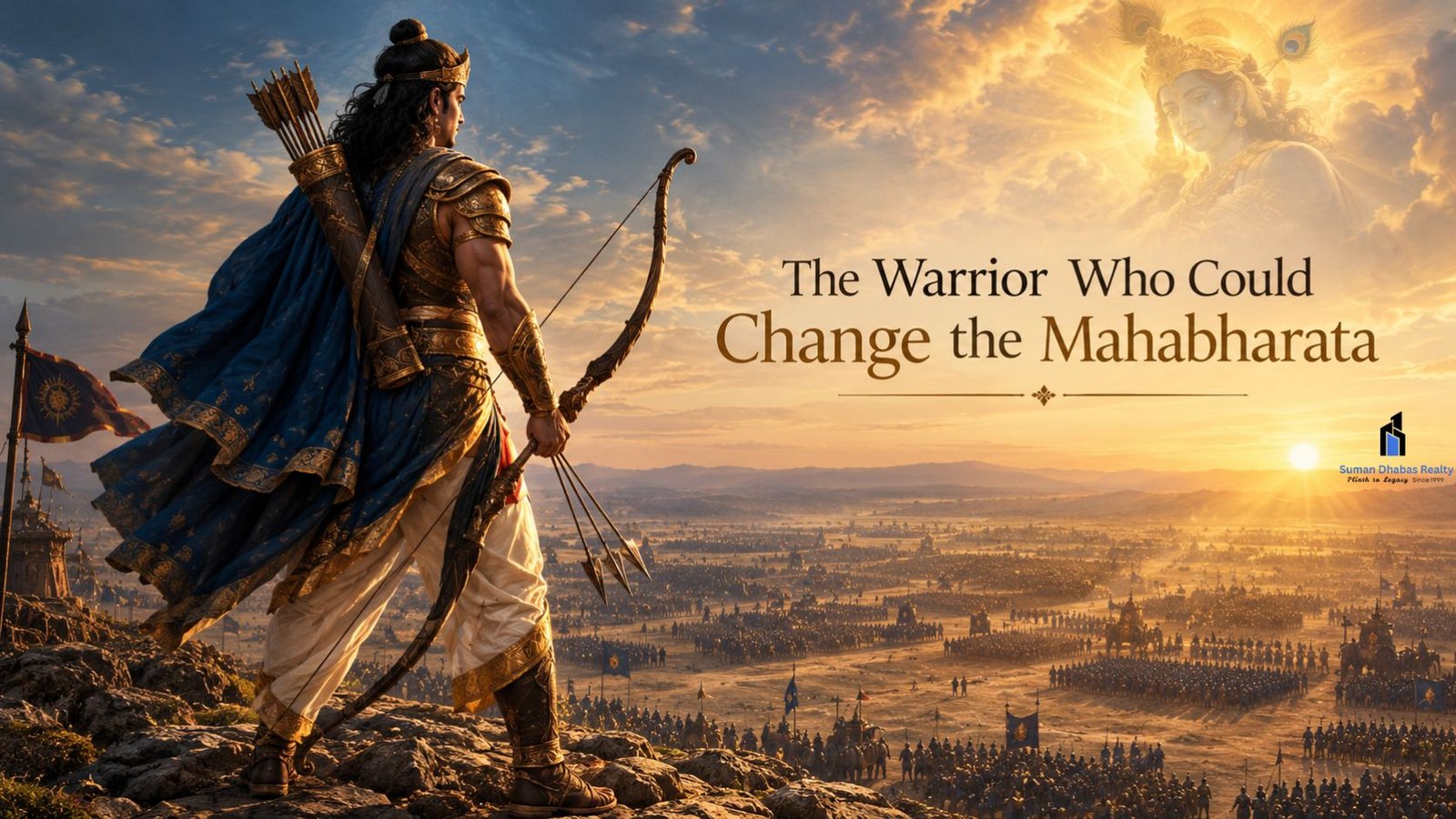
The Warrior Who Could Change the Mahabharata is often identified with Barbarika, the legendary warrior known for his extraordinary three arrows. He was the son of Ghatotkacha and the grandson of Bhima. According to the Mahabharata tradition surrounding Barbarika, his ability was so powerful that Krishna recognized it could dramatically affect the outcome of the Kurukshetra war.
Barbarika did not fight in the eighteen-day battle. Instead, an encounter with Krishna before the war changed his fate. His story remains closely connected with the traditions of Khatu Shyam and is remembered by devotees across India.
Who Was the Warrior Who Could Change the War?
Barbarika was the son of Ghatotkacha, Bhima’s son, and therefore belonged to the Pandava family through his father. Different traditional accounts describe his mother as Maurvi, also known as Ahilawati in some versions.
From an early age, Barbarika trained in warfare and became an exceptionally skilled warrior. His most famous possession was a set of three powerful arrows.
According to the popular legend, these arrows gave him an unusual advantage. One arrow could mark the targets that needed to be destroyed, another could identify those that should be protected, and the final arrow could complete the task. Because of this ability, Barbarika believed that he could accomplish what ordinary armies could not.
Why Were His Three Arrows So Powerful?
The three-arrow legend forms the central part of Barbarika’s story.
Barbarika also had a promise to support the weaker side in the conflict. This promise created a serious problem. The balance between the Pandavas and Kauravas could change during the battle. If Barbarika repeatedly changed sides to support whichever army became weaker, his intervention could potentially continue until only one side remained.
That is why the Warrior Who Could Change the course of the war became an important figure in the legend surrounding the Kurukshetra conflict.
Krishna Tests Barbarika
Before the war began, Krishna met Barbarika while disguised as a Brahmin, according to the traditional account.
Krishna questioned Barbarika about his strength and asked how quickly he could finish the war. Barbarika explained the power of his three arrows. Krishna then decided to test his abilities.
One famous episode describes Krishna asking Barbarika to demonstrate whether his arrow could identify all the leaves on a tree. Barbarika’s arrow reportedly marked every leaf, including one hidden beneath Krishna’s foot.
This demonstration convinced Krishna that Barbarika possessed an extraordinary weapon.
The Sacrifice Before the War
Krishna then asked Barbarika about his promise to support the weaker side. Barbarika’s answer revealed the difficulty his participation could create.
Krishna explained that the battle required a sacrifice before it began. Barbarika agreed to offer his head as a sacrifice.
According to the legend, Barbarika’s head was placed on a hill from where he could observe the entire eighteen-day war. He therefore became a witness rather than a participant in the battle.
This is one of the most important parts of the story of the Warrior Who Could Change the Mahabharata.
What Did Barbarika See?
Traditional accounts say that Barbarika watched the battle from his elevated position. After the war, Krishna asked him who was responsible for the victory.
Barbarika is traditionally said to have identified Krishna’s divine presence as the decisive force behind the Pandavas’ victory. In some versions, he described the battlefield as being dominated by Krishna’s influence and the actions of divine power.
The episode highlights a recurring theme in Indian epic traditions: great warriors may possess enormous strength, yet the larger outcome of a conflict can depend on strategy, duty, destiny, and divine intervention.
Connection Between Barbarika and Khatu Shyam
Barbarika’s story has a particularly strong connection with Khatu Shyam in Rajasthan. According to local religious tradition, Krishna granted Barbarika the name Shyam and a boon that he would be worshipped in the future.
The temple town of Khatu in Rajasthan is therefore closely associated with this tradition. The Khatu Shyam Temple attracts large numbers of devotees, especially during major religious occasions and the annual Phalguna fair.
For people visiting Khatu Shyam, the story of Barbarika adds an important cultural dimension to the journey. It connects the town with one of the most memorable warrior legends associated with the Mahabharata.
The growing interest in Khatu Shyam has also encouraged attention toward residential development and planned communities around the wider area. Suman Dhabas Realty Pvt Ltd is associated with a township project in Khatu Shyam, adding another dimension to the area’s ongoing development.
Why Is Barbarika Still Remembered?
Barbarika’s story continues to attract attention because it combines warfare, sacrifice, loyalty, and devotion. His legendary three arrows represent extraordinary martial power, while his decision to honour his promise demonstrates the importance given to one’s word in the traditional narrative.
Although Barbarika did not take part in the Kurukshetra battle, his story became deeply connected with it. The idea of a warrior who possessed the ability to alter the balance of the battlefield makes his character especially memorable.
The Legacy of the Warrior Who Could Change
The Warrior Who Could Change the course of the Mahabharata is therefore remembered not because he fought in the great battle, but because his extraordinary abilities could have transformed its progression.
Barbarika’s story also explains why his tradition remains important at Khatu Shyam today. From the three-arrow legend to his sacrifice and connection with Krishna, each part of the story contributes to his enduring place in Indian religious and cultural traditions.
For visitors exploring Khatu Shyam, understanding Barbarika’s story can make the journey more meaningful. It offers a glimpse into how an ancient epic continues to influence the cultural identity of a place centuries later.