Property documents can sometimes be confusing. Terms like patta, lease deed, sale deed, and registry often appear together. Among these, JDA Patta vs Society Patta is an important comparison for property buyers in Jaipur and Rajasthan. Both can relate to residential plots, but their background and documentation may differ.
The Jaipur Development Authority (JDA) has separate services for JDA schemes and cooperative societies. It also provides different lease deed and patta services for these categories. Therefore, buyers should understand the source of a patta before relying on it.
What Is a JDA Patta?
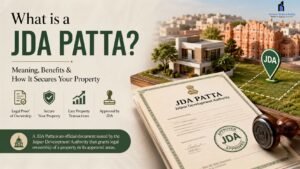
A JDA Patta is generally associated with property covered by a JDA scheme or a relevant JDA process. The Jaipur Development Authority provides services related to lease deeds, pattas, name transfers, and property verification.
JDA’s website also lists a separate service for lease deed or patta for JDA schemes. It provides online property verification and property ledger services as well.
A JDA-related property document may include details such as:
- Plot number
- Plot area
- Owner or allottee name
- Scheme details
- Property location
- Lease conditions
- Relevant authority details
However, the term “JDA Patta” alone should not be treated as proof of a completely clear property title. The complete document history still needs to be checked.
What Is a Society Patta?
A Society Patta is generally connected with a cooperative housing society or society-based residential scheme.
The society may have developed or managed the scheme. However, buyers should also examine the relevant government approvals and land records.
JDA itself lists a separate category for lease deed or patta for cooperative societies. It also has services relating to cooperative societies and different approval situations.
Therefore, a Society Patta should be examined along with the society’s documents, approved layout, land records, and other applicable records.
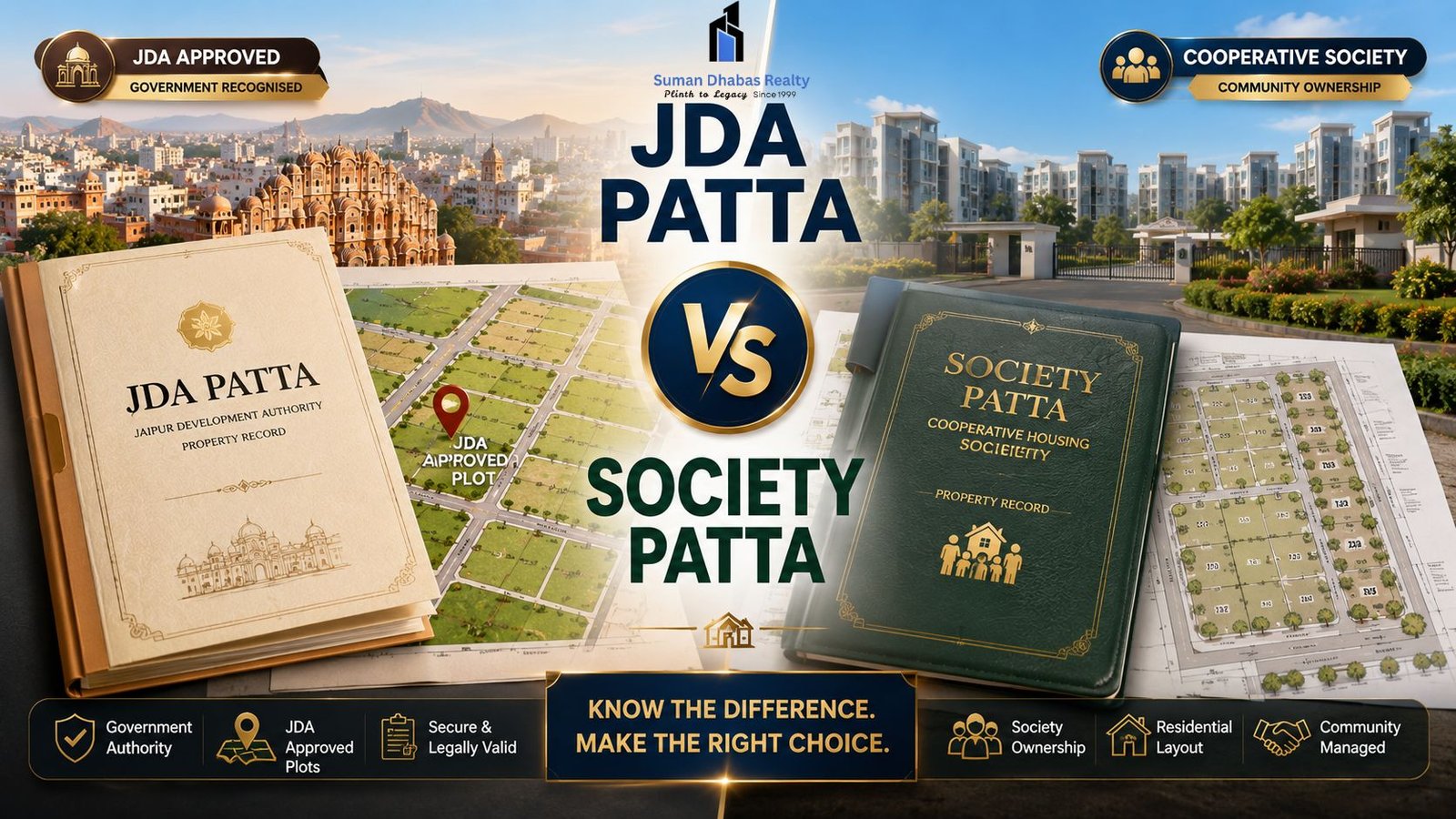
JDA Patta vs Society Patta: Key Differences
The easiest way to understand JDA Patta vs Society Patta is to compare their development and documentation background.
| Factor | JDA Patta | Society Patta |
|---|---|---|
| Main association | JDA scheme or JDA-related process | Cooperative housing society |
| Related body | Jaipur Development Authority | Cooperative society and relevant authorities |
| Scheme type | JDA scheme or applicable JDA process | Society-based residential scheme |
| Verification | Check JDA records and property documents | Check society and government records |
| Layout | Verify applicable JDA-approved layout | Verify approved society scheme/layout |
| Transfer | May involve JDA procedures | May involve society and relevant authority procedures |
| Key check | JDA records and ownership chain | Society records, approvals and ownership chain |
This comparison is general. The actual requirements can vary according to the property’s history and legal status.
JDA Patta vs Society Patta: Which Is Better?
There is no universal answer.
A property should not be considered better simply because it has a JDA Patta or Society Patta. Instead, look at the complete documentation and title history.
First, check the original land ownership. Then examine how the property entered the scheme. Verify the layout and applicable approvals. After that, check the patta and previous transfer documents.
For example, a property may have changed hands several times. In that case, checking only the latest document may not give you the complete picture.
JDA Patta vs Society Patta for Plot Buyers

The difference becomes particularly important when purchasing a residential plot.
If a seller presents a JDA Patta, compare its details with the available JDA records and other ownership documents.
If a seller presents a Society Patta, ask for the society’s relevant records and verify the scheme’s legal background. Also check the approved layout and transfer history.
The JDA portal provides online verification and property ledger facilities that can assist with the initial verification process.
However, online checks should not replace complete legal due diligence.
Documents to Check Before Purchasing
Regardless of the patta type, create a proper document checklist.
Depending on the property, important documents may include:
- Patta or lease deed
- Sale deed
- Previous sale deeds
- Allotment letter
- Possession letter
- Approved layout plan
- Society documents
- Land ownership records
- Relevant land conversion documents
- Property tax or applicable dues
- Name transfer records
- Encumbrance-related records
The exact documents required can vary. Therefore, buyers should verify which documents apply to their particular property.
How to Verify a JDA Patta
Start by checking the basic information.
Compare the owner’s name, plot number, area, scheme, and property location with other available documents.
Next, use the relevant JDA property services where applicable. JDA provides online property verification and property ledger facilities.
Also compare the patta with the sale deed and previous documents. If the details do not match, investigate the difference before proceeding.
How to Verify a Society Patta
For a Society Patta, start by verifying the society and its scheme.
Check the society’s registration and relevant scheme records. Then examine the approved layout and applicable permissions.
You should also trace how the current seller acquired the property. If there were previous transfers, examine those documents too.
Most importantly, do not depend only on a document issued or maintained by the society. Check the underlying land and government records as well.
What About RERA?
RERA can be another useful check for applicable real estate projects.
The Rajasthan RERA portal allows users to search registered projects by details such as district, project name, promoter, registration number, and project type.
For a plotted development or township, check whether RERA applies to the project. However, RERA verification does not replace title and land-document verification.
Common Mistakes to Avoid
One common mistake is assuming that every patta provides the same rights.
Another is checking only the current owner’s document. Buyers may also overlook the approved layout or previous ownership records.
Therefore, compare documents carefully. Also verify the property’s physical location, plot number, boundaries, and area.
For buyers exploring planned developments around Jaipur and the Khatu Shyam region, the same approach is useful. A township may offer planned roads, open spaces, and residential infrastructure, but buyers should still examine the property’s documentation before making a decision.
Suman Dhabas Realty Pvt Ltd is part of the real estate activity in this growing region. For anyone considering a township or plotted development, focusing on documentation, applicable approvals, layout details, and property history can lead to a more informed decision.
JDA Patta vs Society Patta: Final Takeaway
Understanding JDA Patta vs Society Patta can make property research easier.
A JDA-related patta and a society-related patta can come from different development and documentation structures. Because of this, their verification may also involve different records.
The key is not to choose a property based only on the name of its patta. Instead, check the complete ownership chain, approvals, layout, transfers, and applicable government records.
In short, JDA Patta vs Society Patta is less about which label sounds better and more about whether the property has clear, consistent, and verifiable documentation.