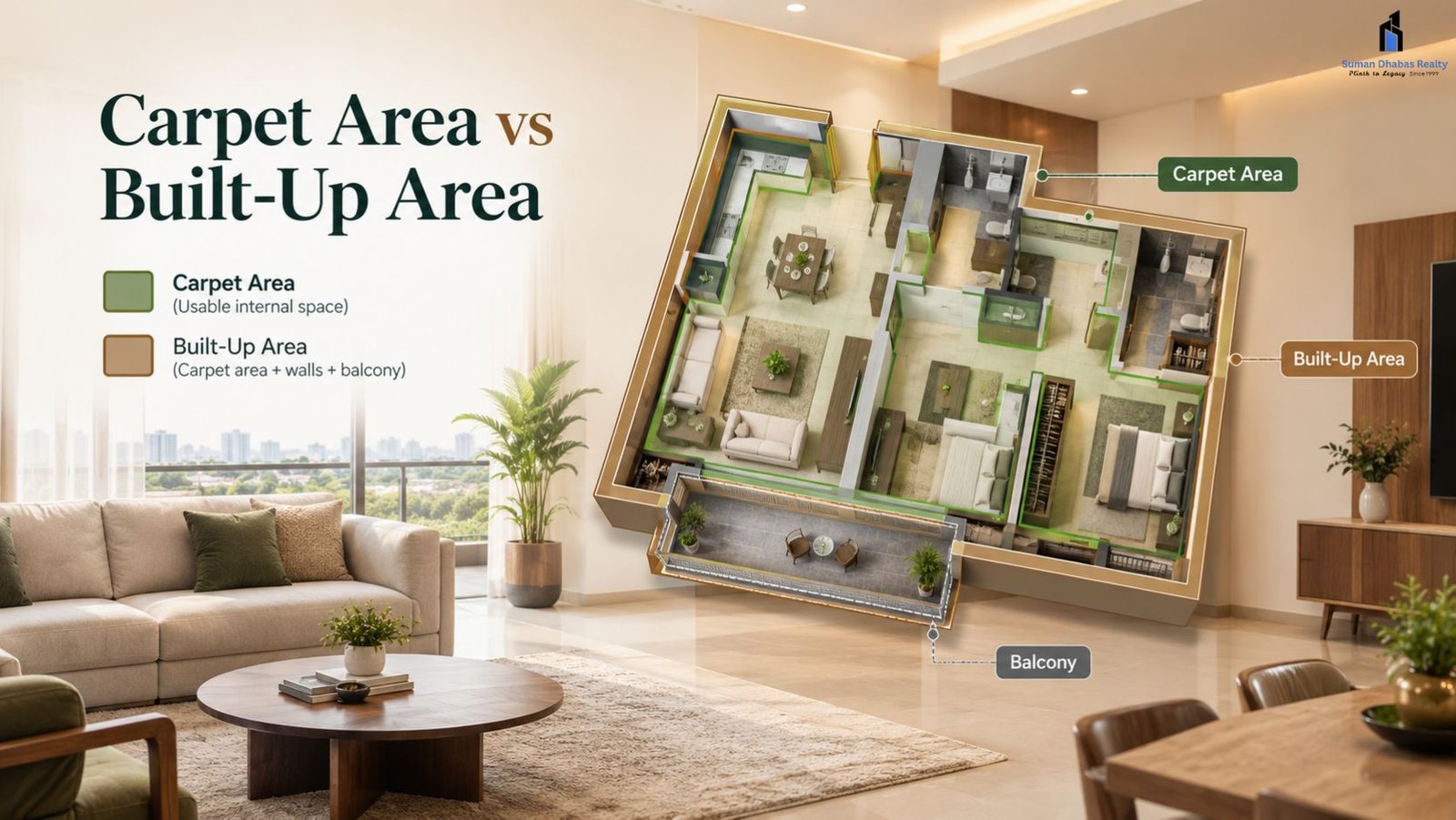
When buying a home, the size mentioned in a property brochure can sometimes be confusing. Carpet area vs built-up area is an important comparison because these two terms describe different measurements of a property. Carpet area focuses mainly on usable floor space, while built-up area includes additional structural elements such as walls and, depending on the property, balconies.
Understanding these measurements helps buyers compare properties more accurately. It also makes it easier to understand what portion of the quoted area can actually be used for everyday living.
What Is Carpet Area?
Carpet area refers to the net usable floor area of an apartment. Under the Real Estate (Regulation and Development) Act, 2016, the RERA definition excludes areas covered by external walls, service shafts, exclusive balconies or verandas, and exclusive open terraces. It does, however, include the area covered by internal partition walls.
In simple terms, carpet area gives you a clearer idea of the space available inside the apartment for regular use.
For example, bedrooms, living rooms, kitchens and bathrooms generally form part of the usable internal space. However, areas such as common corridors and shared facilities do not become part of the apartment’s carpet area.
How Is Carpet Area Calculated?
There is no single percentage that applies to every property because the relationship between carpet area and other measurements depends on the design and construction.
A basic way to understand the measurement is:
Carpet Area = Net usable floor area of the apartment
For a property purchase, buyers should check the carpet area stated in the relevant documents instead of relying only on a general size mentioned in advertisements.
What Is Built-Up Area?
Built-up area generally includes the carpet area along with the area occupied by walls and certain additional spaces connected to the property. Depending on the property’s design and the terminology used by the developer, balconies and other covered structural areas may also be included.
Therefore, built-up area is usually larger than carpet area.
For instance, imagine an apartment with 900 sq ft of carpet area. Once wall thickness and applicable additional areas are included, the built-up area may become higher. The exact difference depends on the floor plan and construction design.
Carpet Area vs Built-Up Area: Main Differences
The easiest way to understand carpet area vs built-up area is to look at what each measurement represents.
| Factor | Carpet Area | Built-Up Area |
|---|---|---|
| Main purpose | Shows usable internal floor space | Shows a larger constructed area |
| Internal rooms | Included | Included |
| Wall area | External wall area excluded under RERA definition | Wall area is generally included |
| Balcony | Exclusive balcony excluded from RERA carpet area | May be included depending on the measurement |
| Common areas | Not included | Generally not included in standard built-up measurement |
| Size | Usually smaller | Usually larger |
The exact calculation can vary with the property’s design and the terminology used in project documents. So, buyers should always check the approved plan and agreement for the precise measurement.
Why Carpet Area Is Important for Homebuyers
Carpet area provides a practical reference for understanding how much usable space a buyer receives inside an apartment.
Suppose two apartments are advertised with similar built-up areas. Their carpet areas may still differ because of variations in wall thickness, balconies, layouts and other design elements.
That is why comparing only the headline area can sometimes give an incomplete picture.
Buyers should also consider the room dimensions, layout efficiency, ventilation, storage and movement space. A well-planned apartment can make better use of its available carpet area than a poorly planned one of a similar size.
How to Compare Properties Using Carpet Area
When comparing two properties, start by checking their carpet areas. Then look at the total price to understand the effective cost against usable internal space.
For example:
- Property A: 900 sq ft carpet area
- Property B: 1,000 sq ft carpet area
If both properties have similar prices, Property B provides more internal floor space. However, price should not be the only consideration. Location, construction quality, amenities, connectivity, maintenance costs and legal documentation also matter.
This approach is particularly useful when evaluating apartments, villas or residential developments where different developers may present area measurements differently.
Carpet Area vs Built-Up Area in Township Projects
The distinction also matters when buyers evaluate homes within planned residential communities. In a township, the individual property’s area should be considered separately from roads, parks, landscaped areas and other community infrastructure.
For example, Suman Dhabas Realty Pvt Ltd develops plotted developments, villas and other residential formats, with planning and project execution handled through an integrated approach. Its website also highlights its experience across Jaipur and other markets.
For buyers considering a township, understanding the property’s actual area can make comparisons clearer. It is also useful to review the layout, specifications and applicable project documents before making a decision.
Common Mistakes Buyers Should Avoid
While evaluating carpet area vs built-up area, buyers should avoid relying on a single number from a brochure.
Instead, check:
- The carpet area mentioned in the agreement.
- The approved floor plan and dimensions.
- Whether balconies or terraces are listed separately.
- The total property price and applicable charges.
- The project’s registration and documentation, where applicable.
- Whether the quoted area matches the relevant property documents.
RERA’s standardised carpet-area definition was introduced to provide greater clarity about apartment measurements.
Final Thoughts
Knowing the difference between carpet area vs built-up area can make property comparisons more meaningful. Carpet area focuses on the usable floor space of an apartment, while built-up area generally adds walls and certain additional constructed areas.
Before purchasing, compare the carpet area, floor plan, total price and property documents together. This gives you a more realistic understanding of the home you are considering and helps avoid confusion caused by different area measurements.