
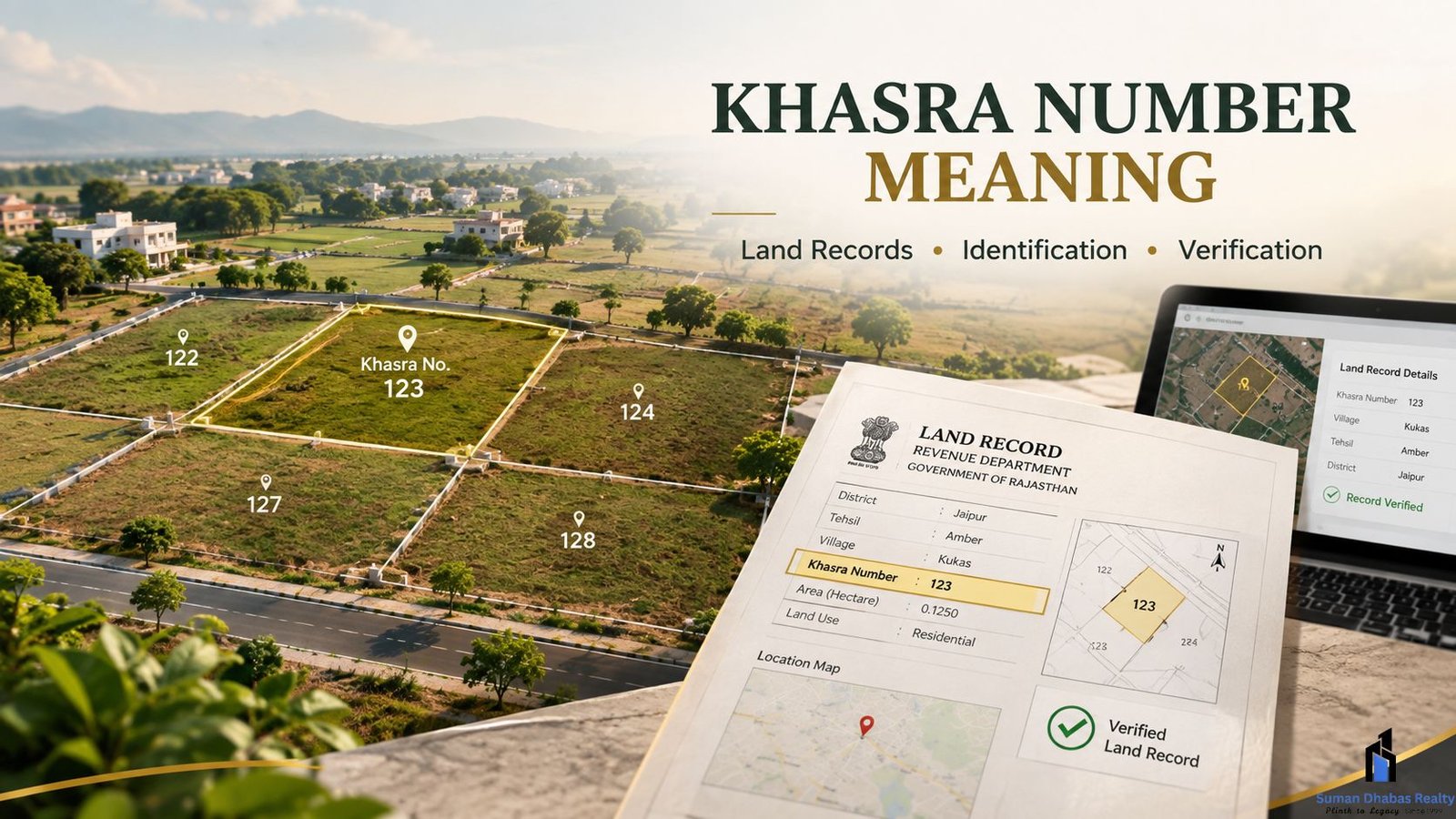
When dealing with land records, buyers often come across terms such as Khasra number, Khata number, Jamabandi, and Patta. Understanding these terms can make property research much easier. Khasra Number Meaning is especially important because the number helps identify a specific piece of land in official revenue records.
A Khasra number is commonly used to identify and track land parcels. It can help connect a physical piece of land with its recorded details. Therefore, buyers should understand what a Khasra number represents before purchasing agricultural land, residential plots, or other properties.
What Is a Khasra Number?
A Khasra number is a unique identification number assigned to a particular parcel of land in land or revenue records.
In simple terms, you can think of it as an identification number for a specific land parcel. Government revenue records use these numbers to distinguish one parcel from another.
For example, a large piece of land may be divided into several parcels. Each parcel can have a separate Khasra number in the relevant land records.
The number may be linked with information such as:
- Location of the land
- Area of the parcel
- Land classification
- Recorded holder or tenure information
- Boundaries
- Revenue details
- Changes or transactions recorded over time
The exact information available can differ between states and their land-record systems.
Khasra Number Meaning in Simple Words
The easiest way to understand Khasra Number Meaning is to remember:
Khasra number = identification number of a land parcel in revenue records.
It helps authorities and property stakeholders identify a particular parcel and distinguish it from neighbouring parcels.
However, a Khasra number by itself should not be treated as complete proof of ownership. Ownership and title require examination of relevant documents and records.
Why Is a Khasra Number Important?
A Khasra number becomes useful when researching a property’s background.
Suppose you are considering purchasing a plot. The seller provides a location and some property documents. The Khasra number can help you match the land with the relevant revenue records.
This can help with:
1. Identifying the Land
A Khasra number helps identify the particular parcel referred to in land records.
2. Checking Land Records
The number can be used when searching applicable government land records, depending on the state’s digital system.
3. Comparing Property Details
Buyers can compare the recorded area and location with the information provided by the seller.
4. Understanding Boundaries
Revenue records and associated maps may provide information that helps establish the location and boundaries of a parcel.
5. Property Due Diligence
Khasra details can form one part of a broader property due diligence process.
How to Find a Khasra Number
The process for finding a Khasra number depends on the state and the available land-record services.
In many places, you may be able to search land records online using details such as:
- District
- Tehsil
- Village
- Owner or holder name
- Account details
- Survey or parcel information
For Rajasthan properties, buyers can also check the relevant Rajasthan land records and revenue services provided through government platforms.
When possible, compare online records with the property’s official documents rather than relying on a single source.
Is a Khasra Number Proof of Ownership?
No. This is an important point.
Knowing the Khasra Number Meaning does not mean that you can establish ownership simply by looking at the number.
A Khasra number identifies a parcel in revenue records. Ownership and title may require examination of sale deeds, previous title documents, mutation records, revenue records, encumbrance information, approvals, and other applicable documents.
Therefore, a buyer should not rely solely on a Khasra number before making a property purchase.
Why Buyers Should Verify the Khasra Number
Before purchasing land, make sure the property details match across relevant documents.
Check whether:
- The Khasra number matches the available records.
- The recorded area matches the property being offered.
- The location corresponds with the actual land.
- Boundaries are consistent.
- The seller has the relevant authority to transfer the property.
- There are any recorded disputes or restrictions.
- Required approvals are available for the intended use.
These checks can help identify inconsistencies before you commit significant money to a property.
Khasra Number and Land Buying
Understanding Khasra Number Meaning is particularly useful when researching land in developing areas. A property may look suitable on the ground, but its official records still need verification.
For buyers exploring plotted developments around Jaipur and the Khatu Shyam region, checking land identification details can be an important part of the overall research process. It helps create a clearer picture of the parcel before moving toward documentation and registration.
Suman Dhabas Realty Pvt Ltd‘s township-related property context can also be discussed alongside broader topics such as land records, location research, infrastructure, and property documentation. The focus should remain on helping buyers understand the research process rather than treating the Khasra number as a standalone ownership document.
Final Thoughts
The simplest Khasra Number Meaning is the identification number used for a specific parcel of land in revenue records. It can help buyers and authorities identify land and connect it with relevant records.
However, a Khasra number is only one part of property verification. Before buying land, always compare the Khasra details with the title documents, revenue records, boundaries, approvals, and other relevant information.
A clear land record is a starting point, not a substitute for complete property due diligence.



Pingback: How to Perform a Legal Land Verification
Pingback: Property Buying Mistakes: Common Errors to Avoid - Suman Dhabas Realty
Pingback: Land Background Check: A Complete Guide for Property Buyers - Suman Dhabas Realty