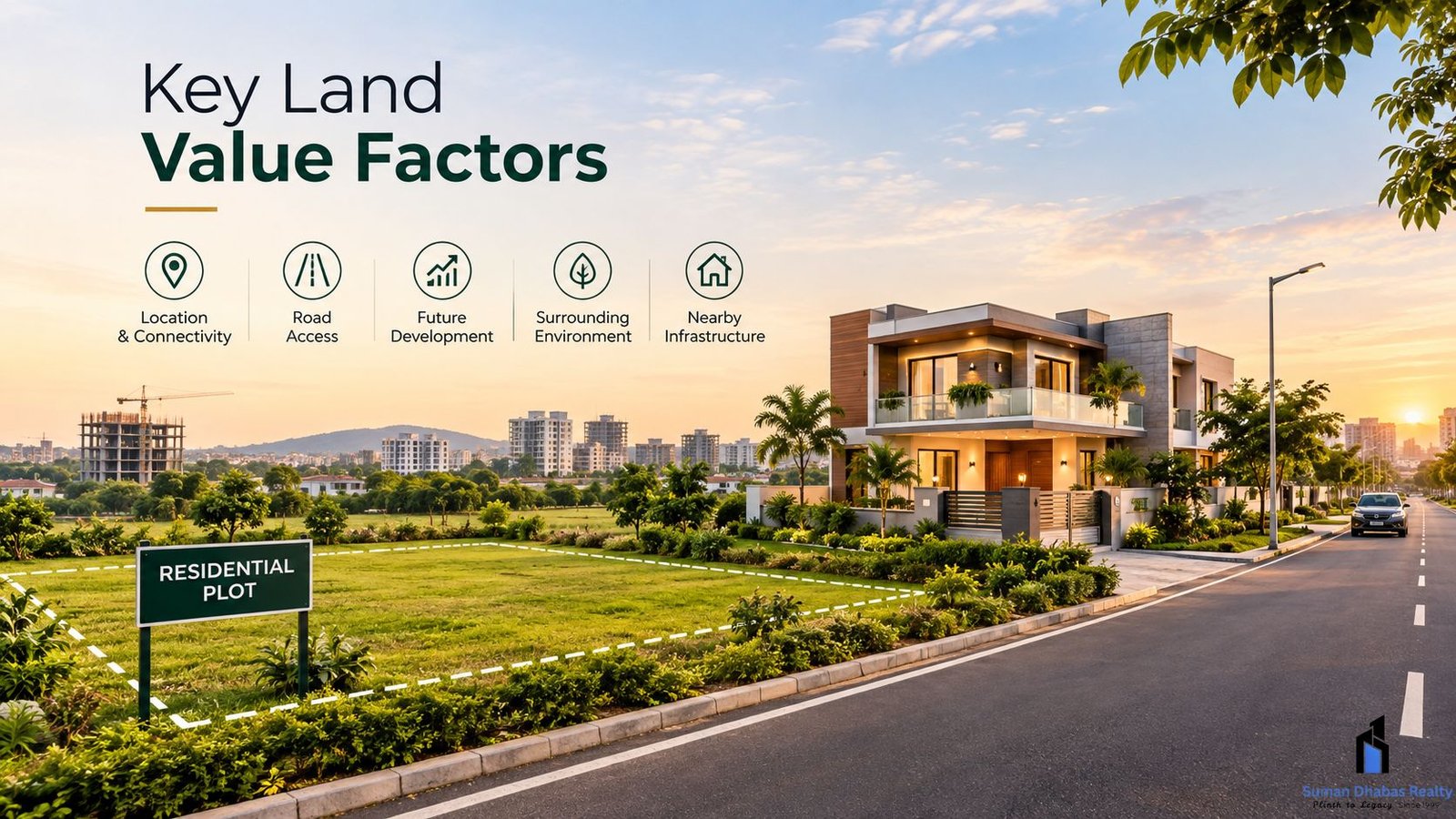
Land prices can vary significantly, even between nearby locations. One plot may attract strong demand, while another may remain affordable for years. This difference often comes down to several Key Land Value Factors.
Location is important, but it is not the only consideration. Road connectivity, infrastructure, nearby development, demand, land use and future growth can also influence value.
Therefore, buyers should look at the complete picture before judging whether a plot is fairly priced.
Understanding these factors can also help investors compare different areas more logically.
1. Location Is a Major Factor
Location is usually one of the first things buyers consider.
A plot near established residential areas, commercial centres, schools, hospitals and major roads may attract stronger demand. On the other hand, an isolated location may take longer to develop.
However, a good location does not always mean a central city location.
Developing areas can also become attractive when infrastructure and connectivity improve. Therefore, investors should study both the current situation and the area’s development pattern.
Key Land Value Factors Within a Location
Look beyond the area’s name.
Check the exact position of the property. Two plots in the same locality can have different values because of their road access, surroundings and nearby facilities.
Consider:
- Main road access
- Nearby residential areas
- Schools and hospitals
- Markets and shopping areas
- Employment centres
- Public transport
- Nearby commercial activity
- Overall neighbourhood development
These details can make a significant difference over time.
2. Road Connectivity and Accessibility
Good connectivity can make land more useful.
People generally prefer properties that are easy to reach. As a result, roads can have a direct effect on demand.
Check the actual access road rather than relying only on a property brochure.
Also consider the road width, nearby highways and connections to important parts of the city.
For example, a developing area with improving road infrastructure may become more accessible to homebuyers. Consequently, demand can change as travel becomes easier.
Still, buyers should verify proposed infrastructure instead of assuming every future road or project will be completed as advertised.
3. Infrastructure and Basic Services
Infrastructure is another important part of land value.
A plot may have a good location, but limited infrastructure can reduce its immediate usability.
Check the availability of:
- Roads
- Electricity
- Water supply
- Drainage
- Street lighting
- Internet connectivity
- Waste management
- Public transport
Established infrastructure can support existing demand. Meanwhile, planned infrastructure may influence future interest.
However, planned facilities should be evaluated carefully. Look for credible information instead of relying only on verbal promises.
4. Residential and Commercial Development
Surrounding development can provide useful clues about an area’s future.
Look at nearby construction activity. Are new homes being built? Are shops opening? Are residential projects expanding?
If more people and businesses move into an area, demand for nearby land may increase.
At the same time, rapid development does not automatically guarantee appreciation. Investors should consider the quality and sustainability of that development.
5. Supply and Demand
Basic market principles also affect land prices.
When demand is high and suitable land is limited, prices can rise. Conversely, an area with many available plots and limited buyer interest may experience slower price growth.
Therefore, research the local market before investing.
Compare similar plots in the same area. Check their size, location, road access and development status.
This gives you a better idea of whether the asking price is reasonable.
6. Land Use and Development Potential
Land use can strongly influence value.
Residential land, commercial land, agricultural land and other categories may have different uses and restrictions.
Before buying, confirm the property’s current land-use status and understand what development is legally permitted.
For example, a plot that cannot legally support your intended use may have limited practical value.
Therefore, do not judge land only by its size or location. Check the relevant records and approvals as well.
7. Plot Size and Shape
Size matters, but shape matters too.
A larger plot can offer more development options. However, an irregularly shaped plot may be harder to plan.
Similarly, a narrow plot may have limitations even when its total area looks attractive.
Check the:
- Plot dimensions
- Frontage
- Depth
- Shape
- Road-facing side
- Access points
- Setbacks applicable to development
These details can affect both usability and buyer demand.
8. Nearby Amenities
Amenities can make an area more convenient.
Schools, hospitals, markets, parks and recreational facilities can increase the appeal of a neighbourhood.
For residential buyers, these facilities can be particularly important.
However, proximity alone is not enough. Check whether the amenities are actually operational and accessible.
A proposed shopping centre may sound attractive, but an existing market may have greater value for someone planning to live there soon.
9. Future Growth Potential
One of the most discussed Key Land Value Factors is future growth.
Investors often look for areas that may develop over the next five, ten or more years.
Look for signs such as:
- New roads
- Expanding residential areas
- New commercial activity
- Better connectivity
- Employment opportunities
- Educational institutions
- Tourism growth
- Planned infrastructure
For instance, areas around major pilgrimage or tourism destinations can experience changes in hospitality, transport and local business activity.
Khatu Shyam and its surrounding region offer an example of how tourism, connectivity and residential development can influence local interest. However, buyers should still evaluate each property independently rather than assuming that regional growth guarantees appreciation.
10. Planned Township Development
Planned developments can offer a different land-buying experience compared with isolated plots.
A township may bring together roads, open spaces, landscaping and other planned features within a larger layout.
This broader planning can influence how buyers view the location and its long-term usability.
Suman Dhabas Realty Pvt. Ltd. works across plotted developments and residential projects, with planning and development forming part of its wider approach. Its portfolio also includes plotted developments, villas and other real estate formats.
For buyers exploring residential opportunities around Jaipur and Khatu Shyam, the larger development plan can therefore be worth studying alongside the individual plot.
Still, buyers should independently check title, approvals, land use, infrastructure and other applicable documents before investing.
11. Legal Status and Documentation
Legal clarity is one of the most important factors when evaluating land.
A property with unclear ownership or incomplete documentation can create serious problems.
Before buying, check relevant documents such as:
- Ownership records
- Title documents
- Previous sale deeds
- Land-use status
- Approved layout
- Encumbrance information
- Plot dimensions
- Road access
- Applicable approvals
- RERA registration, where applicable
Also compare the documents with the physical property.
If the details do not match, investigate the issue before making a payment.
12. Surrounding Environment
The surrounding environment can also influence land value.
A clean and well-maintained neighbourhood may appeal more to residential buyers. Similarly, open spaces, greenery and lower congestion can improve the overall living experience.
On the other hand, heavy industrial activity, poor drainage, excessive traffic or environmental concerns may affect demand.
Therefore, visit the location at different times of the day. This can reveal details that a single site visit may miss.
How to Evaluate Land Value Before Buying
You do not need to depend on one factor.
Instead, create a simple comparison.
First, study the location and connectivity. Next, compare nearby land prices. Then, check infrastructure and development.
After that, verify the legal documents and land-use status. Finally, consider the area’s future potential.
This approach can help you avoid choosing a property simply because it looks inexpensive.
Key Land Value Factors Checklist
Before making a decision, ask:
- Is the location well connected?
- Is the road access clear?
- Are basic services available?
- Is development happening nearby?
- Is there genuine buyer demand?
- Is the land legally suitable for the intended use?
- Are ownership documents clear?
- Does the plot have practical dimensions?
- Are nearby amenities available?
- Is future growth supported by real infrastructure plans?
- Is the asking price comparable with similar properties?
The more answers you can verify, the more informed your decision becomes.
Common Mistakes When Judging Land Value
Many buyers make the mistake of focusing only on the current price.
A low price does not automatically mean good value.
Some also assume that every developing area will deliver rapid appreciation. However, development can take longer than expected.
Another common mistake is ignoring legal checks. A property with attractive surroundings still needs proper documentation.
Finally, avoid comparing properties using only their price per square foot. Location, road access, plot shape, development and legal status can make two similarly sized plots very different investments.
Final Thoughts
The Key Land Value Factors go far beyond location and price. Connectivity, infrastructure, development, demand, land use, plot characteristics and legal clarity all deserve attention.
Future growth can also matter. However, investors should support their expectations with real evidence instead of relying on speculation.
Before buying land, visit the property, compare similar plots and verify the relevant documents. Most importantly, look at both the present condition and the realistic future potential.
A well-researched property decision starts with understanding what actually creates value.