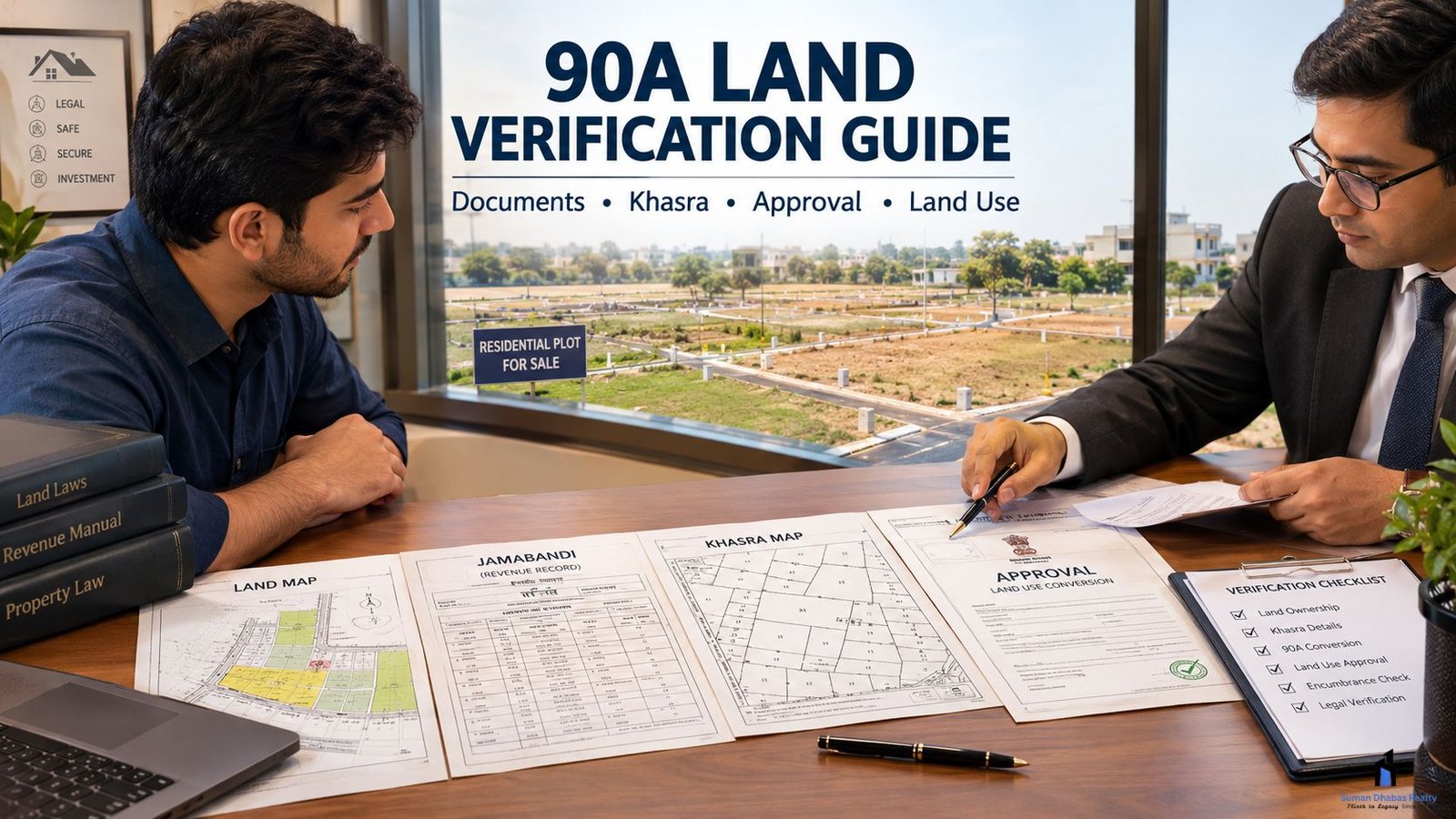
Buying land requires careful document checking. This is especially true when the property involves 90A land conversion. A proper 90A Land Verification Guide can help buyers understand the documents, records, and approvals they should review before purchasing land.
In Rajasthan, Section 90A is linked with the conversion of agricultural land for non-agricultural use in applicable urban areas. The Rajasthan government also provides online services related to 90A land conversion.
However, a 90A order alone does not complete the verification process. Buyers should also check ownership, revenue records, land area, maps, land use, and other applicable permissions.
What Is 90A Land Conversion?
Section 90A deals with the use of agricultural land for non-agricultural purposes in applicable urban areas.
For example, land may be converted for a permitted residential or commercial purpose. The exact requirements can depend on the location and proposed use.
The Rajasthan Revenue Department provides procedures and documents for land conversion applications. These can include the latest Jamabandi, revenue maps, layout plans, and sale or registry documents, depending on the case.
Therefore, buyers should understand the conversion status before purchasing the property.
Why Is 90A Land Verification Important?
A land conversion order can provide important information about the permitted use of the land. Still, it should not be treated as proof that every aspect of the property is clear.
Instead, look at the complete property record.
During the verification process, pay attention to:
- Khasra number
- Land area
- Owner details
- Latest Jamabandi
- Revenue map
- 90A conversion order
- Land-use purpose
- Site plan
- Approved layout
- Applicable development permissions
- Physical boundaries
These details should broadly match across the relevant documents.
90A Land Verification Guide: Documents to Check
1. Check the 90A Order
The first step in this 90A Land Verification Guide is to examine the actual 90A order.
Check the order number, date, authority, land details, and purpose of conversion.
Most importantly, compare the land mentioned in the order with the property being offered to you.
If the Khasra number or area does not match, stop and investigate the difference.
2. Verify the Latest Jamabandi
Jamabandi is an important revenue record.
The latest available revenue record can help you understand the recorded ownership and land particulars.
Rajasthan authorities specifically include the latest Jamabandi among the documents required for certain 90A applications.
Compare the owner’s name, Khasra number, area, and other relevant details.
Do not rely only on a photocopy provided by the seller. Where necessary, obtain records through the appropriate government channels and seek professional verification.
3. Match the Khasra Number
The Khasra number helps identify a specific parcel of land.
It should match across the relevant documents.
Check the Khasra number in:
- 90A order
- Jamabandi
- Revenue map
- Sale documents
- Approved plans
- Other applicable property records
A mismatch can indicate a documentation issue or a difference in the land being offered.
Therefore, never ignore even a small discrepancy.
Verify the Land Area
The land area should also match across the important documents.
For instance, the area mentioned in the 90A documents should be compared with the revenue records and sale documents.
After that, compare the documents with the actual site.
This step becomes even more important when you are buying a plot from a larger land parcel. The plot offered to you should be clearly identifiable within the approved or relevant layout.
Check the Land-Use Purpose
Another important part of the 90A Land Verification Guide is checking the permitted land use.
A 90A conversion relates to the permitted use of agricultural land for a non-agricultural purpose. However, buyers should still check the specific purpose mentioned in the relevant documents.
For a residential plot, confirm that the proposed use is consistent with the applicable permissions.
Also, check whether additional project or development approvals apply.
Remember that land conversion and project-level approvals are not always the same thing.
Check Maps and Boundaries
Maps can help connect the documents with the actual property.
Start by reviewing the relevant revenue map and site plan. Then, compare the location with the physical property.
During a site visit, look at:
- Road access
- Plot boundaries
- Nearby properties
- Entry and exit points
- Physical landmarks
- Plot dimensions
- Surrounding development
Rajasthan’s land-conversion documentation can include a relevant revenue map and, in applicable cases, a layout plan for residential colonies or industrial areas.
As a result, map verification should be an important part of your due diligence.
Check for Restrictions or Legal Issues
Property verification should go beyond ownership and land conversion.
Buyers should also investigate possible legal restrictions. These may include disputes, acquisition issues, government restrictions, or other matters affecting the land.
The exact checks will depend on the property and its location.
Therefore, complicated cases should be reviewed by a qualified property lawyer or another relevant professional.
Do not rely only on information provided by a seller or salesperson.
Check the Approved Layout
If you are buying a plot within a township or plotted development, review the overall layout as well.
The layout can show the location of roads, plots, parks, open spaces, and other common areas.
Compare the plot number and location with the documents provided to you.
Furthermore, check whether the actual development matches the approved or relevant plans.
This is especially useful when buying property in a developing area.
90A Verification for Township Projects
Township projects require a wider verification process.
First, check the land and conversion documents. Next, review the layout and applicable project approvals. Finally, visit the site and compare the development with the documents.
For buyers exploring planned developments around Jaipur and the Khatu Shyam region, Suman Dhabas Realty Pvt. Ltd. has a portfolio that includes plotted developments and other real-estate projects. The company’s approach includes planning and development across different stages of a project. Suman Dhabas Realty Pvt. Ltd.
Still, buyers should independently verify the title, approvals, conversion status, layout, and other property documents before making a purchase.
How to Verify 90A Land Step by Step
A clear sequence can make the process easier.
Begin with the 90A order. Note the order number, date, land details, and permitted use.
Next, compare the Jamabandi. Make sure the important land and ownership details are consistent.
Then, match the Khasra number. Look for the same number across the relevant records.
After that, verify the land area. Compare the area shown in different documents.
At this stage, review the land use. Confirm that the intended property use matches the applicable permission.
Meanwhile, examine the maps. Compare the revenue map, site plan, and actual location.
For plotted projects, review the layout. Check the plot number, roads, open spaces, and other common areas.
Before making a payment, investigate legal issues. Look for any known restriction, dispute, or other concern.
Once the documents appear consistent, visit the property. Check the boundaries, access, surroundings, and actual location.
Finally, seek professional advice when needed. A property lawyer can review complicated documents and explain potential risks.
This structure also makes the process easier for readers to follow without repeating the same sentence opening.
Common Mistakes During 90A Land Verification
Relying Only on the 90A Order
A 90A order is important. However, it is only one part of property due diligence.
Ownership and other relevant records also need attention.
Ignoring Document Differences
Small differences can cause bigger problems later.
Therefore, compare the Khasra number, area, owner’s name, and property location across the available records.
Skipping the Site Visit
Documents cannot show everything.
A physical visit can help you understand the actual boundaries, road access, surrounding development, and location.
Trusting Verbal Promises
Always ask for important claims in writing.
If someone says that an approval, road, facility, or development permission exists, ask for the relevant document.
This simple step can prevent confusion later.
Final Checklist for 90A Land Verification
Before purchasing land, review the following:
- 90A conversion order
- Latest Jamabandi
- Khasra number
- Revenue map
- Land area
- Land-use purpose
- Sale deed and ownership records
- Site plan
- Approved layout, where applicable
- Applicable development permissions
- Physical boundaries
- Road access
- Project-level approvals
- Relevant legal checks
Conclusion
A proper 90A Land Verification Guide can help buyers understand the key checks involved in a property purchase.
Start with the 90A order. Then, compare the Jamabandi, Khasra number, land area, maps, and ownership records. After that, review the land-use purpose and applicable approvals.
For township projects, look at the larger development too. Roads, open spaces, layouts, access, and project permissions can all matter.
Most importantly, do not rush because of a sales deadline or limited-time offer. Take time to review the documents and visit the property.
If any detail seems unclear, ask questions before making a payment. For complex cases, professional legal verification can provide an additional layer of protection.
A careful approach may take more time at the beginning. However, it can help reduce avoidable legal and financial risks later.